
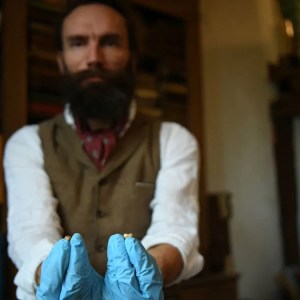
In 2015, a team of paleoanthropologists led by Ludovic Slimak made an incredible discovery in a cave in Rhône Valley, France. They found a jawbone belonging to a Neanderthal, dating back about 42,000 years. This sparked a journey of uncovering more remains and ultimately led to analyzing the genome of this ancient human ancestor, who they named Thorin.
What makes Thorin special is that his lineage stayed isolated, even though other Neanderthals and early modern humans lived nearby. This isolation lasted for over 50,000 years. As Slimak pointed out, this raises fascinating questions about human evolution and how groups can develop in isolation despite proximity.
The research team, having found enough remains, was able to analyze Thorin’s genome. Their findings, published in the journal Cell Genomics, revealed high genetic homozygosity, indicating significant inbreeding within his population. Surprisingly, there was no evidence of interbreeding with early modern humans. This suggests Thorin and his kind lived entirely apart from their contemporaries, which is quite remarkable.
Slimak had hypothesized for years that Neanderthals in this region would exhibit different traits from their neighbors, based on the tools used by each group. This theory turned out to be accurate, pointing to long-term isolation. He noted, “How can we imagine populations that lived for 50 millennia in isolation while they are only two weeks’ walk from each other?”
This discovery challenges long-held views about how and why certain human populations became extinct and why Homo sapiens became the last surviving human lineage.
As interest grows in human history, social media reactions highlight a mix of fascination and concern about our ancient relatives. Many users marvel at the idea of living in a world so close to Neanderthals yet being entirely separate. Discussions online often touch on how this new understanding influences our views on human identity and diversity.
This story not only enriches our understanding of human evolution but also invites us to reflect on our world today—how isolation and proximity could still shape societies in modern times.
For a deeper dive into the genetic research findings, check out the publication in Cell Genomics here.
Source link
Thorin, Ludovic Slimak, Rhône Valley, Neanderthal, Thorin in the Hobbit
