
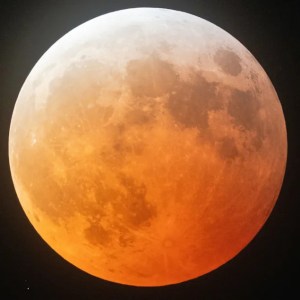
A lunar eclipse and “blood moon” will grace the sky on September 7. This isn’t just any regular moon; during a lunar eclipse, the moon takes on a striking red color when it enters Earth’s shadow. This phenomenon is most dramatic at the totality point of the eclipse.
About 85% of people worldwide will have the chance to see this event. However, anyone in the Americas will miss out since the moon will be hidden below the horizon. Lunar eclipses only happen roughly twice a year, making this the last one in 2025, with the next one on March 3, 2026, as per NASA.
### What Happens During a Lunar Eclipse?
A lunar eclipse occurs when the Earth is positioned right between the moon and the sun. When this happens, Earth’s shadow blocks sunlight from reaching the moon, causing it to dim. Interestingly, a lunar eclipse can only take place when the moon is in a full moon phase. This is when the moon is fully visible from our planet.
Despite the frequency of full moons—occurring every month—eclipses are rarer because they depend on the moon’s orbital angle relative to Earth. NASA explains that these specific alignments are essential for an eclipse to happen.
### Understanding the “Blood Moon”
So, why is it called a “blood moon”? The moon appears red during the eclipse because sunlight filters through Earth’s atmosphere, scattering away the blue light. The remaining light then reflects onto the moon, giving it that eerie red glow, as NASA describes.
### When and Where to Watch?
The eclipse will begin at 11:28 a.m. ET. Totality, when the moon is completely within the shadow, will occur at 1:30 p.m. ET, and the entire event will last around five hours and 27 minutes. The blood moon itself will be visible for about 82 minutes.
People in Australia, Asia, Africa, and Eastern Europe will have the best views. Some parts of Western Europe, like the U.K. and Spain, will see a partial eclipse, but stargazers in the Americas will be out of luck as the moon will be below the horizon then.
A fun fact is that there’s no risk to your eyes when watching a lunar eclipse. According to the National Weather Service, you can enjoy the view without any special eye protection. If you want a closer look, using binoculars or a telescope is a great idea.
### Expert Insights
Astronomers find lunar eclipses particularly fascinating. Dr. Karen Kim, an astrophysicist, shares that these events offer a unique opportunity for education. “Lunar eclipses help us understand celestial mechanics and the positioning of the Earth, moon, and sun,” she explains.
Statistics show that each lunar eclipse garners attention online, with hashtags trending on social media platforms as people share photos and experiences. This growing interest reflects a wider public fascination with celestial events.
Whether you’re an avid astronomer or just curious about the night sky, the upcoming lunar eclipse is an opportunity to step outside and marvel at the wonders of the universe.
Source link
lunar eclipse, blood moon, eclipse, totality, NASA
