
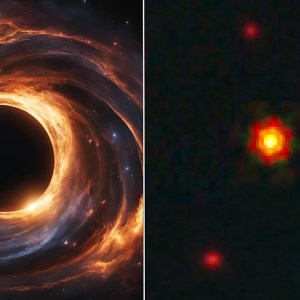
Using the James Webb Space Telescope (JWST), astronomers have uncovered a massive black hole known as BiRD, which existed about 4 billion years after the Big Bang during a time called “cosmic noon.” This era is crucial for understanding how supermassive black holes, which can be millions or even billions of times more massive than our sun, grow.
BiRD is part of a collection called “little red dots,” an intriguing term referring to newly discovered objects that emit infrared light. With a mass of around 100 million suns, BiRD is anything but small. The JWST, with its powerful capabilities, has identified this mysterious object among others in the distant universe.
Interestingly, black holes don’t emit light directly; their immense gravity traps it. However, when they consume surrounding matter, they can shine brightly as quasars. The light from BiRD has been traveling to Earth for about 10 billion years, giving us a glimpse into the distant past.
BiRD was found near a known quasar named J1030, located about 12.5 billion light-years from our planet. Notably, the research team from the National Institute for Astrophysics (INAF) discovered BiRD while analyzing data from the JWST’s infrared camera. They noticed a bright point of light that hadn’t been detected before by X-ray surveys.
Federica Loiacono, the team leader, explained that they could determine BiRD’s distance and mass by studying its light spectrum. The presence of hydrogen and helium in that spectrum offered clues about its makeup and properties. They noted that the black hole’s mass was approximately 100 million times that of our sun.
The little red dots exhibit peculiar characteristics that have intrigued scientists. Some theories propose that these objects could represent a new class of celestial body, possibly early stages of supermassive black holes. There’s debate among scientists as to whether the little red dots are the “seeds” of black holes, still wrapped in gas and dust that blocks high-energy X-rays but allows infrared light to shine through.
BiRD stands out among its peers. Before its discovery, only two other little red dots with similar spectral features existed at this distance. Researchers found that BiRD shares significant traits with these objects, suggesting a common lineage.
This discovery might reshape our understanding of black hole evolution. It was previously believed that these little red dots would have faded from view as cosmic noon passed around 11 billion years ago. However, the team’s research indicates that they were still plentiful during that time.
Looking ahead, Loiacono emphasizes the need for more exploration of nearby little red dots to build a clearer picture of their characteristics. The JWST is paving the way for new insights in extragalactic astrophysics, revealing objects that were previously unknown and pointing to exciting advancements in our understanding of the universe.
For further insights into the evolution of black holes, you can check the research published in Astronomy & Astrophysics.
This ongoing journey of discovery, just beginning, could fundamentally alter how we think about the universe and its formation.
Source link
supermassive black hole, James Webb Space Telescope, black hole, BiRD, little red dots, red dots, Federica Loiacono
