
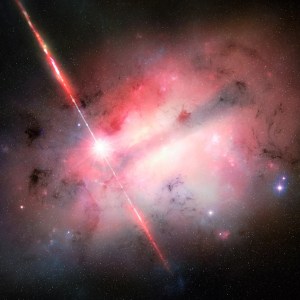
It’s a captivating cosmic mystery: how did a black hole obliterate a star? Astronomers have been buzzing with excitement since July 2 when NASA’s Fermi Gamma-ray Space Telescope sent out alerts about strange gamma-ray signals. These signals are often emitted when black holes devour stars, releasing immense energy.
Typically, these gamma-ray bursts last from a second to half an hour. But this one, known as GRB 250702B, shattered records by lasting over seven hours. This unusual event caught even more attention when the Einstein Probe, a satellite from China and Europe, detected x-ray light from the same spot a day earlier—a reversal of the usual order for cosmic explosions.
“This was a very unusual, exotic explosion that we probably had never seen before,” said Eleonora Troja, an astrophysicist at the University of Rome, Tor Vergata.
Scientists are teeming with theories. Some suggest that this event could have involved smaller black holes, around five to thirty times the mass of the sun. If a black hole merged with a “helium star,” it might have eaten the star from within, generating a jet of high-energy particles. Eric Burns, an astrophysicist, finds the idea thrilling, even if it’s not been conclusively observed before.
However, other researchers believe the real suspect could be an intermediate-mass black hole, a rare type weighing between 100 and 100,000 suns. If it tore apart a white dwarf—the remnant of a sun-like star—it wouldn’t be as explosive as the previous theory but still groundbreaking for our understanding of cosmic physics.
Both theories face challenges. Edwin Levan, another astrophysicist, pointed out how the behavior of the gamma rays, which changed rapidly, suggested a smaller black hole was involved. Larger black holes, he notes, would produce events with slower responses.
Still, there’s no clear answer. Astronomers are diving deeper into the aftermath of the star’s destruction, analyzing x-rays and radio waves for more clues.
Recent surveys indicate that interest in cosmic events like this has spiked on social media, with many people sharing their awe and curiosity. “Every time we open a new window on our universe, it reveals just how much we have yet to learn,” Troja said, reminding us of the wonders that still await discovery.
For now, the investigation continues, blending expert insight and unparalleled cosmic observations to unravel this cosmic riddle. Check out more about cosmic phenomena here.
Source link
black hole, gamma ray, supermassive black hole, gamma ray bursts, star, Fermi Telescope
