
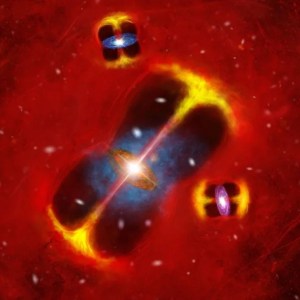
Scientists recently made an eye-opening discovery in one of the universe’s oldest regions. They’re examining a galaxy cluster that formed just 1.4 billion years after the Big Bang. This cluster is hotter and older than what current theories suggest should exist—a finding that could change how we understand the early universe.
In a study published in Nature, lead author and PhD candidate Dazhi Zhou from the University of British Columbia expressed surprise at the findings. “We didn’t expect to see such a hot cluster atmosphere so early,” he remarked. Initially, he was skeptical because the readings were unusually strong. After extensive checks, the team confirmed that the gas is at least five times hotter than predicted. This gas is even more energetic than what we see in many present-day clusters.
The researchers theorize that supermassive black holes within the cluster gave it an unexpected boost early on. Coauthor Scott Chapman from Dalhousie University stated that these black holes likely pumped energy into their surroundings much earlier than previously thought.
Traditionally, scientists believe galaxy clusters gain energy from gravitational forces that pull gases together. However, this research suggests that there might be additional energy sources driving their evolution.
The team used the Atacama Large Millimeter/submillimeter Array (ALMA) in Chile to study a “baby” galaxy cluster called SPT2349-56. This cluster is immense, with a core measuring about half a million light-years across, similar to the halo around our Milky Way but 5,000 times more efficient at star formation.
Zhou wants to decipher how intense star formation, active black holes, and an overheated environment are interconnected. “How can all of this be happening at once in such a young, compact system?” he pondered.
Understanding these galaxy clusters is crucial. Chapman notes that many massive galaxies reside in clusters, and their development is significantly influenced by the clusters’ environments.
This groundbreaking find may not just change our understanding of galaxy clusters but could redefine our view of the universe’s evolution itself. As we learn more, we’ll gain deeper insights into how galaxies formed and continue to evolve.
For further reading, you can explore the original paper in Nature here.
Source link
galaxy cluster, Dalhousie University, Scott Chapman
