
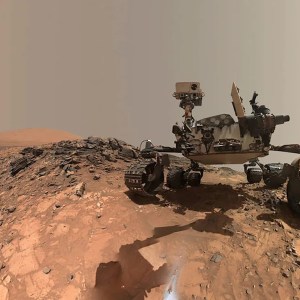
Scientists are making exciting progress in the search for signs of past life on Mars, thanks to the Curiosity rover. This car-sized robot has been exploring the Martian landscape, and its latest find suggests some intriguing possibilities.
About a year ago, Curiosity came across a rock sample with features that caught scientists’ attention. Using its onboard tools, the rover detected organic compounds, substances typically associated with living organisms on Earth. While geological processes can also create these compounds, researchers believe that not all the evidence can be explained by non-biological means. This finding increases the chances that life once existed on Mars, although scientists are careful not to confirm this just yet.
In a study published in February 2026 in the journal Astrobiology, researchers emphasized the importance of further investigation. They pointed out that while some materials on Mars could be produced by geological activity, other evidence hints at biological origins. “We need more studies to completely understand what we’re seeing,” a leading researcher said.
The Curiosity rover launched in 2011 and landed on Mars in 2012, in an area called Gale Crater. This site is believed to have formed around 3.7 billion years ago. Since then, Curiosity has drilled into rocks and collected samples, uncovering clues about Mars’ past.
In March 2026, scientists reported finding trace amounts of fatty acids—important molecules typically produced by living organisms—in a rock sample from Gale Crater. These fatty acids, found in various forms like decane and dodecane, represent some of the largest organic compounds detected on Mars to date.
The presence of these compounds sparked discussions about their origins. Scientists explored whether meteor impacts might account for the fatty acids. They even simulated past conditions on Mars, looking back 80 million years to understand how long these organic materials might have survived under cosmic radiation. Ultimately, they concluded that while some non-biological processes might explain some findings, they couldn’t account for all of them, leaving room for the possibility of ancient life.
While Curiosity has not yet provided definitive proof of life on Mars, its discoveries open up exciting avenues for future exploration. Social media reactions show a growing interest among the public, with many expressing hope that future missions could provide clearer answers.
In summary, the Curiosity rover continues to provide fascinating insights into Mars’ past, fueling excitement about the possibility of life beyond Earth. As research continues, scientists remain committed to understanding the full story behind these organic compounds.
For more on Curiosity and its discoveries, visit NASA’s official site here.
Source link
Curiosity rover, NASA, organic compounds, life on Mars, Mars rover, geological processes
