
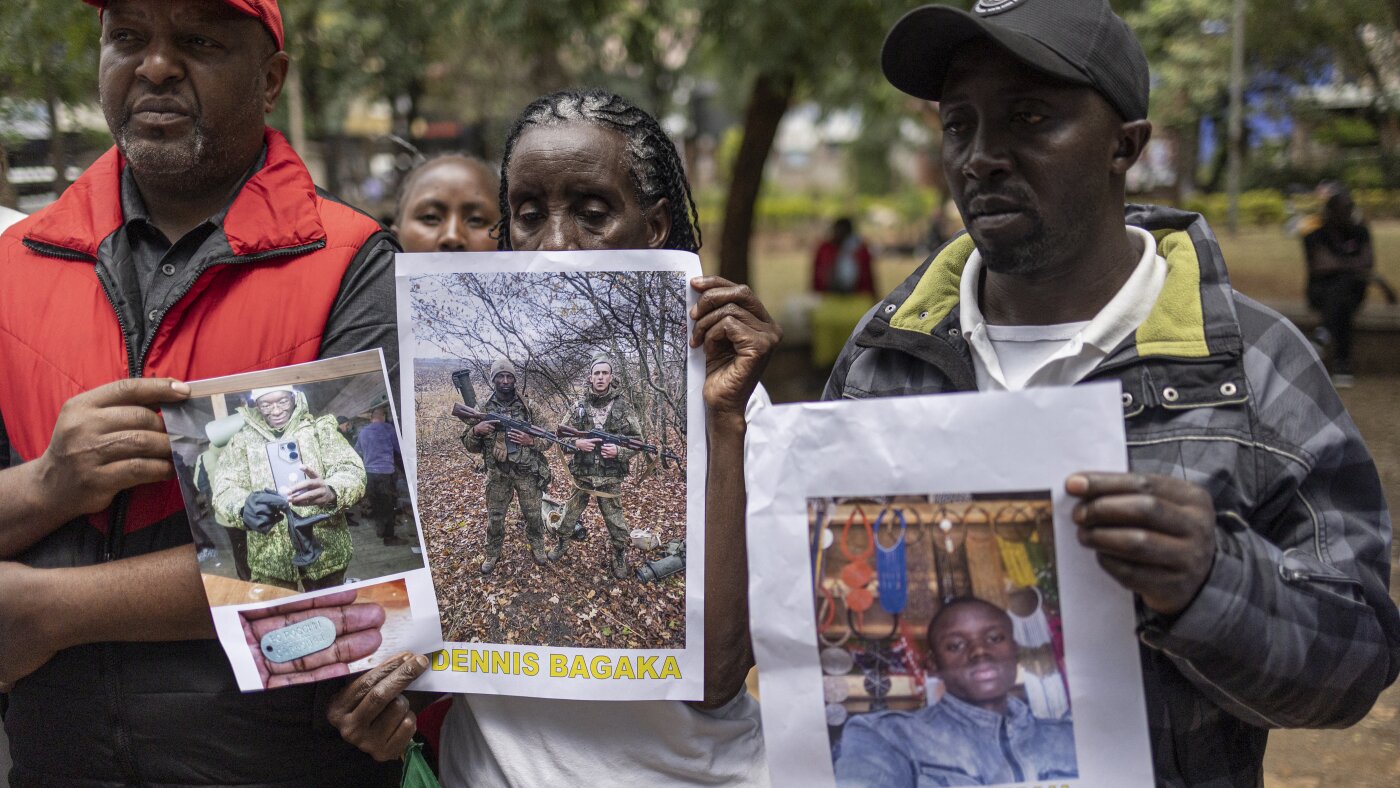
In Sikonga village, Kisii County, a mother’s cries echo through her home. Her son, Dennis Bagaka Ombwori, 39, has been confirmed dead in the Russia–Ukraine war. He was initially a security officer in Qatar when he was approached by recruiters offering a better opportunity. His family believes he never understood what he was getting into.
His brother, Alfred Morara, shared their heartbreak: “They weren’t told the exact job. He was sent to Russia and ended up fighting there.” Similar grief ripples through Nairobi, where the Ogolla family mourns Oscar Agola Ojiambo, 32, who disappeared after joining the Russian army last June. His father, Charles Ojiambo Mutoka, revealed, “We learned he died on August 14, 2025, but the Russian government hasn’t officially informed us.”
Families like the Ombworis and Ogollas feel their hope fade. A recent report by Kenya’s National Intelligence Service estimates that over 1,000 Kenyans are involved in the conflict, a sharp rise from prior estimates. Though the government has promised to identify and repatriate those caught in the war, the scale of the issue is alarming. The report details that 89 Kenyans are currently on the frontline, 39 are hospitalized, and 28 are unaccounted for. Since December, at least 30 have returned home, sharing tales of brutal conditions on the battlefield. Some of the missing might be former members of the Kenya Defence Forces.
Kenyan lawmakers expressed shock at the findings. Majority Leader Kimani Ichung’wah pointed fingers at potential collusion between officials at the Kenyan and Russian embassies in Moscow. “We must identify any officers involved in these activities,” he stated. Opposition MP Joseph Makilap added, “It’s alarming how Kenyans are taken so far to fight in another country’s war.”
Dr. Korir Sing’Oei, from the Ministry of Foreign Affairs, explained that many young Kenyans fall prey to deceptive recruitment networks that promise lucrative jobs abroad. “In their search for work, they often become victims of unscrupulous groups,” he stated. These recruiters entice young men with promises of roles as drivers or security guards, often with salaries that far exceed local rates.
Ichung’wah also mentioned that those recruited face inadequate training. “Nobody trains soldiers for only three weeks. Some are barely prepared,” he said. The Russian Embassy in Nairobi denied these allegations, calling them dangerous and misleading. They asserted no involvement in any rogue recruitment schemes.
These recruitment networks involve both Kenyan and foreign players, with many going through Uganda, South Sudan, or South Africa to evade detection. Reports suggest new recruits can earn a monthly wage of up to 350,000 Kenyan shillings (about $2,400), with enticing bonuses. Yet, many find themselves on the frontlines instead of working in safer, promised jobs.
This situation is not unique to Kenya. In November, Ukraine’s Minister of Foreign Affairs indicated that over 1,400 Africans from more than 30 countries are fighting for Russia. With rising numbers, the urgency for intervention grows.
Kenya’s Foreign Minister is expected to visit Russia to negotiate an end to conscription of Kenyan nationals—a move that gives families like the Ogollas hope. This isn’t just about policy for them; it’s about bringing their loved ones home from a conflict they never asked to be a part of.
