
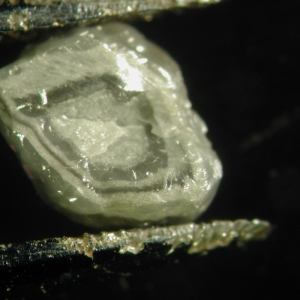
Chinese scientists have created a unique form of diamond known as hexagonal diamond, which is believed to be stronger than conventional diamonds. Until now, hexagonal diamonds were mainly found at meteorite impact sites, and their existence had sparked debate among researchers.
The traditional cubic diamond is known as the hardest mineral on Earth, often used in jewelry, cutting tools, and advanced technology. In contrast, hexagonal diamonds are rare, and their attributes remained largely untested until this new study.
In a recent article published in Nature, researchers from the Henan Key Laboratory of Diamond Materials and Devices detailed their successful lab creation of hexagonal diamond. They used extreme pressure and heat to form a bulk piece from a highly ordered graphite form.
To achieve this, they placed graphite between tungsten carbide anvils and applied around 20 gigapascals of pressure—equivalent to about 200,000 times atmospheric pressure. The process involved temperatures between 1,300°C and 1,900°C, leading to the formation of a millimeter-sized hexagonal diamond.
To confirm the diamond’s structure, scientists employed X-ray diffraction, which maps the atomic positions in a material. By using advanced microscopy, they successfully visualized the hexagonal pattern of the carbon atoms.
When they tested the hardness of the new material, the hexagonal diamond exhibited a hardness of approximately 114 gigapascals, slightly outperforming natural diamonds, which generally have a hardness around 110 gigapascals. This discovery not only resolves the long-standing uncertainty about hexagonal diamonds but also sheds light on the transition of graphite to diamond.
Experts highlight the potential implications of this find. Materials scientist Dr. Jane Smith noted, “This could open new doors in material science, especially for applications requiring extreme durability.” Moreover, with the growing demand for innovative materials in industries like aerospace and electronics, hexagonal diamonds could have significant future applications.
In conclusion, the successful creation of hexagonal diamond marks a pivotal moment in material science. It blends history with cutting-edge techniques, paving the way for future exploration and use in advanced technology.
Source link
hexagonal diamond, cubic diamond
