
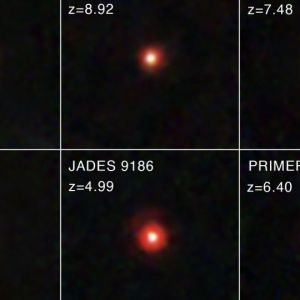
Like unexpected guests, tiny bright red points called “little red dots” (LRDs) have become the talk of the astronomy community. Since the James Webb Space Telescope (JWST) launched four years ago, these peculiar objects have popped up in its images, raising questions about what they really are.
Astronomers first noticed these dots while capturing deep space images. Jenny Greene, a professor at Princeton, describes them as a mystery. “Every time we take a deeper look, we find more,” she says. Initially, some thought these dots might be massive galaxies or black holes, but these theories quickly fell apart as new information came in.
Greene has her theories, too. She believes many of these dots likely involve growing black holes. But she admits that with new findings, current assumptions could be flipped again. “Every expectation we’ve had so far has been overturned,” she explains.
Interestingly, the name “little red dots” wasn’t used until a 2024 study by Jorryt Matthee. He opted for this catchy title over the more complex scientific term. JWST has the ability to observe wavelengths of light that other telescopes, like Hubble, couldn’t reach, revealing these dots that appear red due to the universe’s expansion—a phenomenon known as “redshift.”
The source of the color is still debated. Some researchers believe it’s due to dust, while others, including Matthee, think it might be because of hydrogen gas around a central mass. As of now, around 1,000 LRDs have been detected, mostly far away in the early universe. A recent study found three LRDs closer to Earth, suggesting they might be much rarer in our region.
One breakthrough came from a project called RUBIES, led by Anna de Graaff. This survey analyzed thousands of red objects, including LRDs. Among the findings was an object dubbed “The Cliff,” which seemed to challenge early theories. De Graaff noted that The Cliff doesn’t fit neatly into the categories of known galaxies or black holes. It may signify an entirely new type of cosmic object.
This finding offers parallels to theoretical “quasi-stars,” which are thought to be powered by black holes surrounded by gas. Mitch Begelman, a professor in Colorado, predicted their existence years ago. While he finds the similarities compelling, he exercises caution in drawing definitive conclusions.
Current research into LRDs emphasizes their mysterious nature. As scientists investigate further, they hope to uncover the secrets behind these cosmic anomalies. The excitement around LRDs speaks to the ongoing quest for knowledge in our universe, inviting astronomers from various fields to share their insights.
The JWST project, costing around $10 billion, aims to bring to light the unexpected. “I think it has delivered,” de Graaff says. It has presented us with puzzles that could redefine our understanding of space. The little red dots, straddling the line between galaxies and black holes, remind us how much remains to be discovered.
Source link
James Webb, supermassive black holes, black holes, light wavelengths, Jorryt Matthee, strange objects, Jenny Greene
