
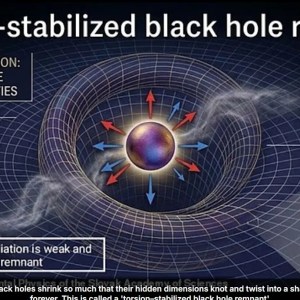
Black holes have long fascinated scientists. Recent theories suggest they might not erase information as once thought. Instead, they could leave behind tiny remnants that keep all the data they’ve absorbed. This idea offers a potential answer to one of the biggest mysteries in cosmology.
### The Seven-Dimensional Idea
Richard Pinčák from the Slovak Academy of Sciences proposes a fascinating model. He suggests our universe has seven dimensions—four we experience directly and three others that are compact and twisted into unique shapes, known as G2-manifolds. Imagine the universe like a piece of origami, where dimensions fold in ways we can’t see.
These hidden dimensions lead to torsion fields, forces that twist spacetime enough to prevent black holes from completely evaporating. According to this model, mass arises from how spacetime is structured, rather than from undiscovered particles.
### Tiny Remnants with Big Consequences
When black holes evaporate, they might leave behind incredibly dense remnants. Picture squeezing a smartphone’s storage into something much smaller than a grain of sand. These remnants could hold all the information that fell into the black hole, potentially solving the violent clash between quantum mechanics and general relativity.
Interestingly, these remnants might even make up dark matter, the 27% of the universe’s mass that we can’t see. This twist makes our understanding of the universe much richer and could change the way we view physics.
### The Detection Dilemma
Detecting these remnants, however, is a huge challenge. Current technology, like the Large Hadron Collider, is not enough. But future tools, such as advanced gravitational wave detectors, might find clues. Pinčák’s model goes beyond abstract ideas and offers testable predictions, grounding the theory in real science.
In summary, the exploration of black holes and their connections to dark matter is a thrilling field. With ongoing research, we might soon uncover new truths that reshape our view of the universe.
Source link
Black holes, Slovak Academy of Sciences, theoretical physics, torsion fields, dark matter, subatomic particles
