
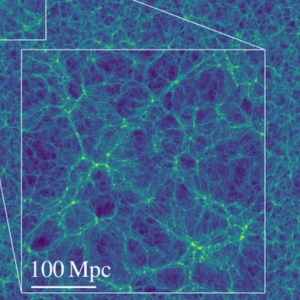
Astronomers have introduced an incredible new dataset that allows us to explore the universe like never before. This is part of the FLAMINGO project, which stands for Full-hydro Large-scale structure simulations with All-sky Mapping. The dataset is enormous, containing over 2.5 petabytes of information—about the same as half a million HD movies.
Modern telescopes are capturing stunning details of the universe. However, to truly understand this data, we need simulations that can mimic both the large-scale structures of galaxies and the intricate physics within them. The FLAMINGO project addresses this need.
Joop Schaye, a researcher from Leiden University, explains, “These simulations allow us to follow the growth of cosmic structures in extensive regions, while also modelling the complex physics of galaxy formation.” With FLAMINGO, scientists hope that researchers everywhere will experiment with its data to gain insights into the universe.
What makes FLAMINGO stand out? Unlike older simulations, it can model both dark matter and ordinary matter, alongside dark energy, in one cohesive framework. This means researchers can study how different processes interact on various scales. For example, the same simulation can examine the physics of stars forming in galaxies while mapping galaxy clusters across vast distances.
The dataset’s size also makes it invaluable for examining rare cosmic events. Big galaxy clusters and bright quasars are tricky to find in smaller datasets because they appear infrequently. But with FLAMINGO’s expansive scale, the chances of discovering these unusual phenomena increase significantly.
This project is crucial not just for individual findings but also for guiding researchers with fresh data from next-generation observatories. As these observatories capture the universe’s details, scientists need robust theoretical models—like those FLAMINGO provides—to make sense of their observations.
Matthew Schaller, another researcher on the team, mentions, “Open access to datasets of this scale can significantly accelerate scientific progress.” This openness is vital in a field that increasingly relies on collaboration and shared resources across the globe.
Ultimately, FLAMINGO represents a change in how we study the cosmos. Instead of only relying on direct observations, researchers can now delve into detailed virtual universes to test theories, make predictions, and uncover hidden patterns. The dataset was submitted to Astronomy & Computing on April 28 and can be accessed on the arXiv preprint server, making it available for researchers worldwide.
For anyone fascinated by space and science, this development opens new doors for understanding the universe. It reflects a growing trend in science: using extensive data to deepen our knowledge and push the boundaries of what we know.
Source link
galaxy clusters, Joop Schaye, FLAMINGO, simulation, the universe, Leiden University, cosmic structure, galaxy formation, FLAMINGO
