
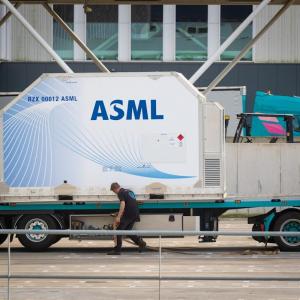
ASML Holding, a key player in semiconductor equipment, recently adjusted its sales outlook for next year, citing ongoing trade disputes and global tensions. CEO Christophe Fouquet emphasized the uncertainty stemming from economic and geopolitical factors, affecting their growth predictions. While ASML aims for growth in 2026, it can’t guarantee it right now.
This uncertainty has impacted ASML’s stock, which dropped by 8.5% in one day, marking its biggest decrease since April. Over the last year, shares have fallen by 32%. As the sole manufacturer of extreme ultraviolet lithography machines, ASML plays a vital role in producing advanced chips vital for technologies like artificial intelligence and smartphones.
Recent data shows that ASML expects net sales between €7.4 billion and €7.9 billion for the third quarter, falling short of analyst predictions. Despite these challenges, CFO Roger Dassen noted that clients are hesitant to commit due to the unclear landscape of tariffs and export controls.
Interestingly, the latest developments in U.S. policy may benefit ASML. Companies like Nvidia and AMD recently resumed sales of AI processors to China, suggesting a potential lift in demand for ASML’s equipment. Dassen hinted that if U.S. bans were alleviated, global demand for chips could soar.
China has been a significant market for ASML, with about 27% of system sales coming from there. However, due to U.S.-led restrictions, ASML has faced limitations on selling its advanced machines to China. Last year, the Dutch government also restricted sales of certain lithography systems to China, influenced by U.S. pressure.
Despite a shaky market outlook, ASML reported bookings of €5.5 billion in the second quarter, exceeding expectations. These bookings are crucial indicators for future sales, although ASML plans to stop reporting those figures next year, arguing they don’t always reflect business momentum.
In a broader context, the semiconductor industry is navigating a volatile regulatory environment. An ongoing investigation into the semiconductor sector launched by the previous U.S. administration could lead to new tariffs, further adding to the uncertainty.
The global landscape for semiconductors is shifting swiftly, and companies are adapting. ASML’s prospects hinge not only on its technological capabilities but also on the evolving political and economic environment. As both the demand for AI and regulatory measures continue to develop, how these factors play out will be crucial for ASML and the industry as a whole.
Source link
Bloomberg, Christophe Fouquet, ASML, Chief Financial Officer Roger Dassen, Chief Executive Officer, global tensions, uncertainty
