
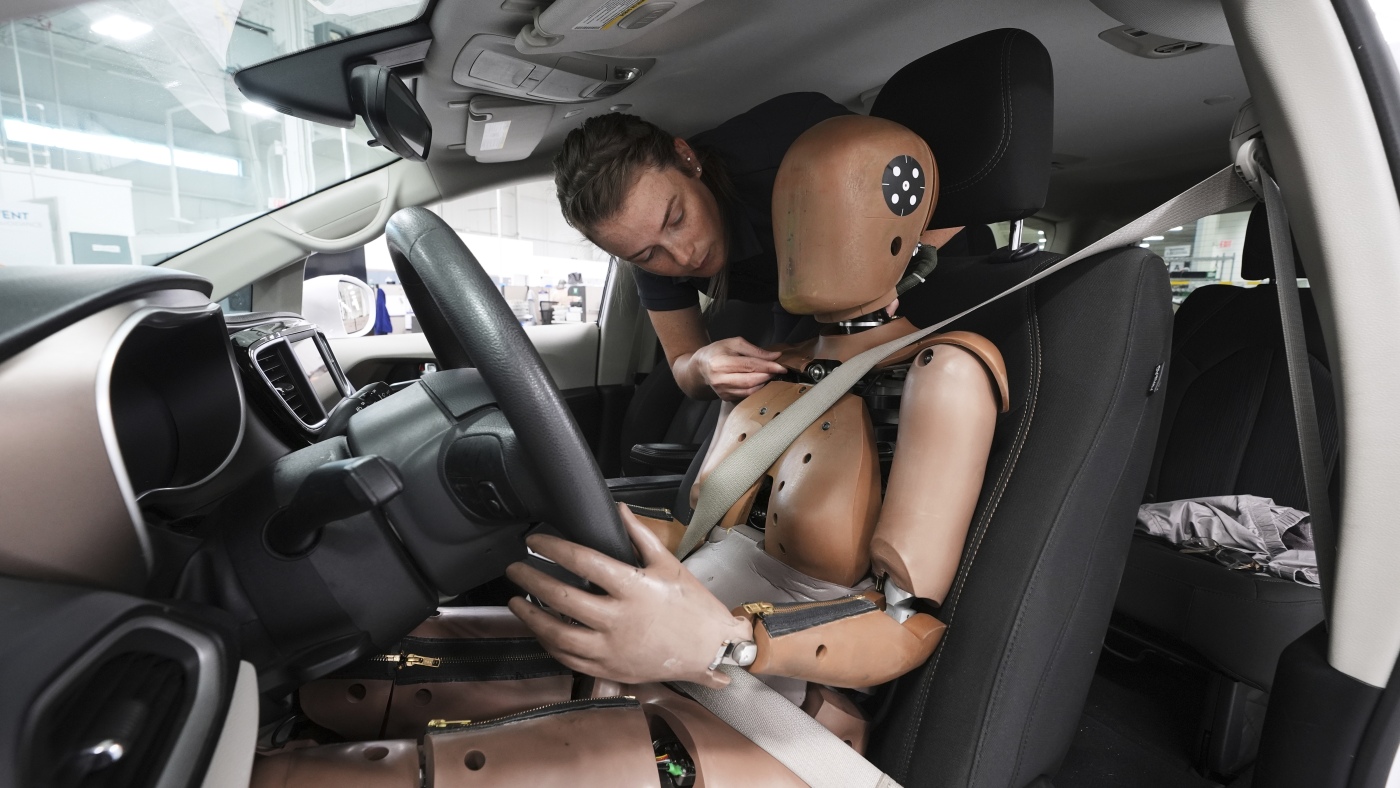
When the Trump administration announced the design of a female crash test dummy, many advocates cheered. They’ve fought for years for better representation in vehicle safety testing.
For far too long, car safety tests in the U.S. have relied on crash test dummies modeled after a male body. This has serious consequences. Studies show women are more likely to sustain injuries in car crashes, even when adjusting for factors like crash severity and vehicle size. Calls for a more accurate female dummy have been around since 1980, according to Consumer Reports.
In the early 2000s, regulators introduced a scaled-down female dummy, but it was merely a modified male version. This doesn’t reflect the real physical differences between genders. The National Highway Traffic Safety Administration (NHTSA) has been collaborating with Humanetics, the leading manufacturer of crash test dummies, to develop a more accurate representation.
The new dummy, named THOR-05F, is designed based on the anatomy of a small female. Chris O’Connor, CEO of Humanetics, notes crucial differences in female anatomy—like a rounded pelvis and variations in neck and leg structure. These distinctions play a major role in injury rates for women during crashes.
Though some countries have embraced this new design, its adoption in the U.S. has been slow, caught up in regulatory red tape. Introducing a new dummy into testing is costly, with each dummy priced over $1 million. The THOR-05F has faced criticism for being too small and not representative of the average woman’s body.
While some groups argue that computer simulations could enhance testing diversity by modeling bodies of various sizes, others stress the need for real-world crash data to inform these models.
This announcement marks a significant, albeit overdue, step toward improving vehicle safety for women. NHTSA Administrator Jonathan Morrison called it a crucial advancement. However, it’s just the beginning. The final rule must still be published, and testing criteria need to be updated before the THOR-05F can be used in official safety tests.
Women Drive Too, an advocacy group, recognizes this progress but points out that more needs to be done. They’re pushing for legislation to ensure these dummies are actually put to use, rather than just being talked about. Even after this announcement, the journey toward effective safety measures for women in vehicles remains a long one.
In these times, it’s essential to stay informed about advancements in vehicle safety and the ongoing discussions around gender representation in testing. Changes like these could save lives and ultimately create a safer driving experience for everyone.
Source link
