
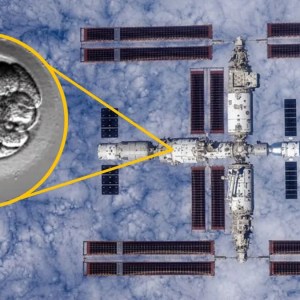
China has made headlines by sending “human artificial embryos” to space for the first time. This experiment aims to explore how microgravity and cosmic radiation affect human reproduction. The findings could be vital for setting up self-sustaining colonies on the Moon and Mars.
On May 11, the Tiangong space station received these embryo-like structures as part of the Tianzhou-10 resupply mission. Alongside the embryos, the mission delivered about 7 tons of essential items like food and scientific materials for the astronauts currently onboard.
These artificial embryos are created from living stem cells. While they can multiply like a normal embryo, they cannot develop into a fetus. This approach reduces ethical concerns around using real human embryos for research. Leqian Yu, a researcher from the Chinese Academy of Sciences, described them as models to study early human development without the ability to grow into individuals.
The experiment uses two types of embryos representing different stages of development—one that mimics the attachment phase to the uterine wall and another that simulates the early tissue organization phase. After a five-day growth period in space, the embryos will be frozen for further analysis on Earth.
There’s a broader significance to this research. As space travel becomes more commonplace, experts warn that tourists may engage in activities leading to potential pregnancies in space. Understanding how reproduction works off Earth will become increasingly important.
However, challenges lie ahead. Research suggests that high radiation levels may harm embryos, while microgravity complicates fertilization. A study even pointed out that sperm cells could be disoriented in space, making fertilization less likely.
These hurdles raise the question of whether natural reproduction is feasible in space. Experts propose that in vitro fertilization (IVF) might be the best solution, a notion already being evaluated by many private space firms.
Yu emphasizes the importance of this research, stating that understanding such critical early development stages can help assess future possibilities for human reproduction in space.
This study is not standing alone; similar experiments with zebrafish and mouse embryos were also launched during the mission. As we venture deeper into a new era of space exploration, the quest to answer whether life can begin away from Earth continues, presenting both fascinating opportunities and significant challenges.
For more details about China’s advancements in space science, check out Live Science.
Source link
space station, human reproduction, China, stem cells, human embryo, Leqian Yu, artificial embryos, Tiangong, scientific experiments, Chinese astronauts
