
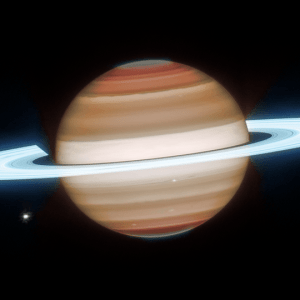
NASA’s James Webb Space Telescope just delivered some stunning new infrared images of Saturn, the planet known for its spectacular rings. This groundbreaking telescope, launched on Christmas Day in 2021, allows scientists to see deeper into Saturn’s atmosphere than ever before, uncovering details that were previously hidden.
The Hubble Space Telescope has been observing Saturn and the other outer planets as part of its OPAL initiative, which has gathered atmospheric data for years. But now, Webb’s infrared capabilities are adding a new layer of information. This helps researchers better understand changes in the planet’s atmosphere, especially as Saturn moves into its southern spring and eventually into summer over the next several years.
The latest data shows Saturn’s rings glowing brightly. This luminosity comes from ice particles that reflect sunlight. The images also reveal cloud bands and subtle variations caused by winds and temperature shifts in the atmosphere. Webb’s ability to detect infrared light is crucial for studying how the gases and clouds interact at different altitudes, which is essential given Saturn’s variable and dynamic weather systems.
A Closer Look at Saturn’s Moons
The images also highlight some of Saturn’s moons, including Janus, Dione, and Enceladus. Among these, Enceladus stands out. It has a hidden ocean beneath its icy crust and spews water vapor and ice grains into space. This makes it one of the most significant places to search for life beyond Earth.
The Hexagon at Saturn’s Pole
One of Saturn’s most intriguing features is its hexagon-shaped jet stream at the north pole. Discovered by NASA’s Voyager spacecraft in the 1980s, this stable weather pattern has fascinated scientists for decades. Interestingly, these may be some of the last high-resolution images of the hexagon until the 2040s as the area will soon enter a long winter.
Another exciting observation from Webb is a faint greenish glow over Saturn’s poles. This glow might be linked to high-altitude aerosols or auroras, formed when charged particles interact with Saturn’s magnetic field. These emissions provide valuable clues about the composition and behavior of the planet’s upper atmosphere.
The Future of Saturn Observation
Saturn will soon be more visible in our night sky. Starting in June 2026, it will rise in the morning and later be visible around midnight. By October, it will reach its brightest, making it easier for both amateur and professional astronomers to observe.
With data from both the James Webb and Hubble telescopes, scientists are excited about what these advancements mean for understanding Saturn and its complex atmosphere. As we gather more information, we deepen our appreciation for the unique features of our solar system.
For more in-depth insights, you can explore the latest findings from NASA on their official website.
Source link
Hubble Space Telescope, James Webb Space Telescope, NASA, Rings Of Saturn, infrared image of Saturn, STScI, NASA-GSFC, Saturn, Jupiter, Saturn, Uranus and Neptune
