
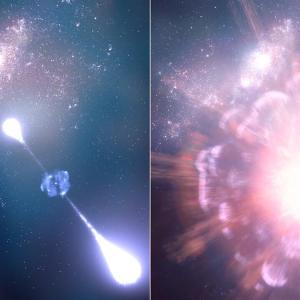
The James Webb Space Telescope recently made an exciting discovery. It detected a supernova that exploded 13 billion years ago, just 730 million years after the Big Bang. This finding is significant because it pushes back the record for the oldest supernova. Previously, the oldest known supernova was from a time when the Universe was 1.8 billion years old.
The European Space Agency (ESA) announced this remarkable sighting, revealing that all of this happened in just about 17 hours, thanks to a collaborative effort between various observatories around the world. For instance, NASA’s Neil Gehrels Swift Observatory first pinpointed the X-ray source, allowing the Webb telescope to follow up with deeper observations. Then, the Nordic Optical Telescope in Spain suggested that the gamma-ray burst was extremely distant, leading to further exploration by the Very Large Telescope in Chile.
Curiously, this ancient explosion appears to share many characteristics with modern-day supernovae. You might expect older stars to be quite different due to fewer heavy elements and their massive sizes. However, scientists were surprised to find that this supernova looked very similar to what we see today.
Andrew Levan, a co-author of the study, expressed the excitement about using the Webb telescope to study stars from such an early time in the Universe. He noted that detecting gamma-ray bursts from the first billion years of cosmic history is rare, making this find even more valuable.
Looking Back at History
Historically, our understanding of supernovae has evolved significantly. In the past, our telescopes couldn’t see as far into the Universe. With the advent of technologies like the Webb telescope, we can see deeper and clearer, unraveling the mysteries of the early cosmos.
A recent article from NASA stated that only a handful of gamma-ray bursts have been detected from that early era. This makes the discovery of the 13-billion-year-old supernova not just a scientific achievement but a milestone in the journey of exploring the Universe.
The Next Steps
Now that the team has permission to continue studying these ancient gamma-ray bursts, they are optimistic about what they may uncover. Levan believes the observations will help create a clearer picture of early galaxies and contribute to our understanding of cosmic evolution.
This discovery serves to remind us how much there is left to learn about our Universe. Each new finding opens the door to more questions and possibilities, inviting us to explore further into the depths of time and space.
For more details on this breakthrough, you can check out the ESA’s announcement here.
Source link
James Webb Space Telescope, European Space Agency, supernova, international observatories, gamma-ray burst, Andrew Levan, the Universe
