
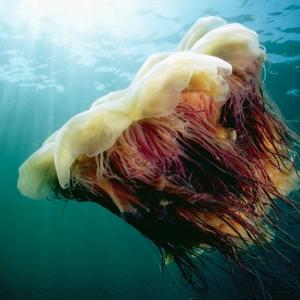
In 1865, a jellyfish washed ashore in Massachusetts, and it was a giant among its kind. This creature, known as the lion’s mane jellyfish (Cyanea capillata), had a bell measuring over 2 meters (7 feet) wide and tentacles stretching an astonishing 36.6 meters (120 feet). This makes it the longest recorded animal on Earth, even surpassing the blue whale in length.
Typically, we think of “largest” animals as the heaviest. The blue whale might hold the title for mass, but when it comes to length, the lion’s mane jellyfish tops the list. It’s fascinating to note that this almost ethereal creature drifts through cold Arctic waters, trailing a multitude of venomous tentacles behind it.
Unique Anatomy
The lion’s mane jellyfish has a distinct structure. Its bell is shaped like an eight-pointed star, divided into lobes, each lined with hundreds of tentacles that contain stinging cells called nematocysts. When triggered, these cells can fire venom at alarmingly fast speeds. This adaptation is critical for its survival as it uses these tentacles to capture prey rather than chasing them down.
Interestingly, the jellyfish is not an efficient swimmer. Though its many tentacles help it catch food, they also slow it down. Research shows that having this extensive tentacle system can reduce a jellyfish’s swimming efficiency by 80 to 90%. However, in cold water with limited food, being able to reach further can be a better strategy than speed.
Composition and Fragility
A surprising feature of the lion’s mane jellyfish is its composition: it’s about 94% water. It has no bones, no heart, and no centralized brain. The body consists mainly of a gelatinous substance, which helps it survive on minimal energy, a vital attribute in nutrient-poor waters.
While this watery form allows it to grow large without the energy demands seen in other animals, it also makes the jellyfish quite fragile. Tentacles can easily break or become entangled.
Environmental Indicators
Lion’s mane jellyfish are becoming vital indicators of ocean health. Factors like climate change, pollution, and overfishing are believed to contribute to jellyfish blooms. A 2024 review in Frontiers in Marine Science pointed out that evidence for widespread blooms is still limited; however, some data indicate jellyfish populations may be rising due to warmer waters and reduced competition.
Researchers believe this could create a feedback loop where overfishing of fish, which naturally compete with jellyfish for food, leads to increased jellyfish numbers. As marine ecosystems change, these jellyfish may thrive at the expense of other sea life.
A Dual Perspective on Size
In terms of size, the blue whale is the heaviest animal ever, needing to consume massive amounts of food daily. The lion’s mane jellyfish, in contrast, is a lightweight, relying on its environment for survival. This emerging dynamic may allow it to exist more sustainably in a warming ocean where food sources are dwindling.
Both the whale and the jellyfish hold unique titles: one for mass, the other for length. As our oceans shift, creatures like the lion’s mane jellyfish remind us of nature’s adaptability. Each represents a significant connection to the ecosystems we share.
Understanding these marine wonders deepens our awareness of ocean health and our role in its future.
Source link
lion’s mane jellyfish, tentacles, Arctic waters, blue whale, The lion’s mane
