
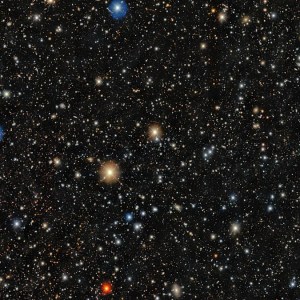
Scientists are stepping into the role of “cosmic archaeologists” as they explore a remarkable discovery: a rare star with extremely low iron content. Known as PicII-503, this second-generation star acts like a fossil, revealing insights about the early universe’s chemistry.
Located in the dwarf galaxy Pictor II, roughly 150,000 light-years from Earth, PicII-503 has an astonishingly low iron concentration—just 1/40,000th that of our sun. This sets it apart as one of the most primordial stars ever detected outside the Milky Way. Surprisingly, it has a high carbon-to-iron ratio, over 1,500 times greater than that of the sun. Researchers believe this distinctive feature links back to the first stars that formed in the universe.
“Findings like this unveil the history of the cosmos, shedding light on the origins of our chemical elements,” says Chris Davis, a program director at the National Science Foundation.
The first stars, known as Population III (POP III), were born in a simpler universe, mostly filled with hydrogen and helium. These stars fused hydrogen into heavier elements, enriching the interstellar medium when they exploded as supernovae. This process laid the groundwork for the second generation, or Population II (POP II) stars, like PicII-503. These stars record a vital chapter in our universe’s chemical evolution.
Recent studies indicate that the supernovae of POP III stars may not have been as energetic as once thought. This could explain why heavy elements like iron remained in their remnants while lighter elements dispersed into space. PicII-503’s discovery suggests these weak explosions happened in low-gravity environments typical of small dwarf galaxies.
Team leader Anirudh Chiti remarked, “We have observed a record from the very beginning of elemental production in a primordial galaxy. This connects the first stars’ legacy to those in the Milky Way halo.” Their research emphasizes the importance of stars like PicII-503 in understanding how early supernovae contributed to the universe’s chemistry.
To ensure accurate measurements, researchers utilized data from the Dark Energy Camera and the Very Large Telescope in Chile. This collaboration demonstrated how dedicated efforts can yield significant scientific breakthroughs.
In a time when space exploration captures the public’s imagination, this discovery resonates well beyond the scientific community. A growing interest in cosmic phenomena showcases how early individual stars offer clues to the universe’s grand narrative. As discoveries continue, we find ourselves more connected to the cosmos, where every star tells a part of our story.
For more insights on the universe and its history, check out articles from reputable sources like NASA or Space.com.
Source link
Anirudh Chiti, dwarf galaxy, iron deficient, Dark Energy Camera, NSF NOIRLab, Stars, POP
