
What Lies Below Us? A Cosmic Perspective
Have you ever thought about what’s beneath the Earth? This question can spark a deep dive into our solar system and beyond.
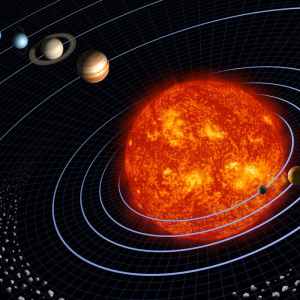
When we look at our solar system, we see that all the planets orbit the Sun in a flat plane. It’s a bit like a pancake with the Sun at the center. But what does “down” really mean in space?
Defining “Down”
Your sense of “down” is influenced mainly by Earth’s gravity. When you stand on solid ground and point down, that direction varies depending on where you are. For instance, if you’re in North America and point downward, your finger would eventually point to someone in the southern Indian Ocean. Fascinating, right?
In astronomy, “down” could also be defined as being below the plane of our solar system, known as the ecliptic. Up is the area above this plane, where the planets orbit counterclockwise around the Sun. Look below, and their motion will seem clockwise.
More Layers of Down
Let’s zoom out. The solar system is just a small part of our galaxy, the Milky Way. This galaxy has about 100 billion stars, and each star has its own planetary system. Like the planets orbiting the Sun, these stars also travel around the center of the Milky Way in a plane known as the galactic plane. Interestingly, the angle between the ecliptic plane and the galactic plane is about 60 degrees.
The concept of “down” keeps changing as we look deeper into space. Our galaxy is part of a local cluster known as the Local Group, which lies within yet another plane called the supergalactic plane.
Origin of the Planes
You might wonder why everything tends to align in these planes. It all goes back to the solar nebula, a vast cloud of gas and dust that formed the Sun and planets. As this nebula collapsed under gravity, it started spinning. This motion led to the creation of the disc shape of our solar system. Similar processes led the stars in our galaxy into their own plane.
So, when you ask, “What’s below Earth?” the answer is complex. There’s no special significance to the direction we call “down.” If you dig deep enough, you’ll eventually find other stars and galaxies, each with their own orientations.
Astronomical Perspective
Interestingly, if you ask people worldwide what “down” means, they would point in various directions. Imagine intelligent life forms from different planets—each would define “down” based on their own gravity.
This curiosity about the cosmos not only answers our questions but also humbles us. Each perspective we gain shows just how vast and intricate our universe really is.
For more insights on our universe, explore NASA resources, which provide detailed visuals and studies about celestial formations and movements. Our understanding continues to expand, reminding us of our place among the stars.
This article is adapted from expertise provided by Jeff Moersch, a planetary scientist at the University of Tennessee, whose work with NASA and the U.S. National Science Foundation furthers our knowledge of space. For a deeper dive, visit NASA.
Source link
Our solar system, galactic plane, solar system, Earth, the Sun, supergalactic plane
