
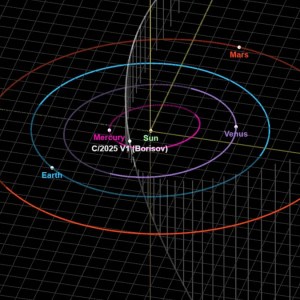
A new comet, C/2025 V1 (Borisov), is on its way to a close encounter with Earth, approaching us on November 11. Discovered by amateur astronomer Gennadiy Borisov, this comet will be about 64 million miles (103 million kilometers) away—270 times farther than the moon. It will swing closest to the sun on November 16.
Interestingly, some have tried to link this new comet to 3I/ATLAS, another famous interstellar object, but scientists confirm they are not related. C/2025 V1 most likely originated from our solar system, possibly from the Oort Cloud, a vast sphere of icy bodies on the edges of our system.
With a brightness of about magnitude 13.8, C/2025 V1 is too faint for the naked eye, but you might catch a glimpse with good binoculars or a telescope. It’s currently in the constellation Virgo and is best viewed before sunrise.
Interestingly, Gennadiy Borisov is known for discovering another interstellar object, famously named Comet Borisov in 2019. Just like 3I/ATLAS, this comet journeyed from a distant star, making its way through space for billions of years until it passed near Earth.
However, some experts, like astrophysicist Avi Loeb from Harvard University, are intrigued by its journey. He describes C/2025 V1’s orbit as “nearly interstellar” due to its unusual trajectory. This has sparked discussions, especially as the comet appears to be missing its typical tail. The buzz on social media has turned some heads, with people speculating if it could be an alien probe; a theory Loeb has entertained in the past.
Experts clarify that this connection is far-fetched. The distance between C/2025 V1 and 3I/ATLAS would likely make such a relationship impossible. In fact, Loeb himself noted that unless C/2025 V1 uses some form of non-gravitational propulsion, the chances of them being related are slim.
For now, C/2025 V1 remains a fascinating discovery, captivating stargazers and scientists alike. As we refine our observations, experts continue to explore its origins and trajectory, hoping to learn more about these celestial visitors from beyond. Meanwhile, 3I/ATLAS has recently re-emerged after passing behind the sun, showing unusual behaviors like color changes and unexpected brightening. Both comets remind us of the complexity and wonder of our universe.
For more on astronomical discoveries, you can check [Orbital Today](https://orbitaltoday.com) and [TheSkyLive](https://theskylive.com).
Source link
Comet Borisov, solar system, Gennadiy Borisov, V1, ISO, closest point, interstellar object, Avi Loeb, Borisov
