
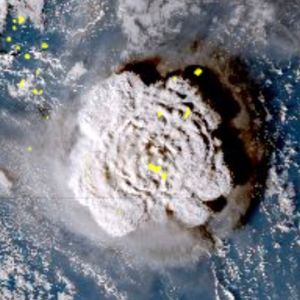
In January 2022, an underwater volcano called Hunga Tonga-Hunga Ha’apai erupted violently, sending ash and gas nearly 40 miles into the sky. This explosion was so powerful that it was hundreds of times stronger than the Hiroshima nuclear blast, causing a tsunami and a sonic boom that circled the globe.
Recent research reveals that this eruption may have unexpectedly helped reduce a potent greenhouse gas: methane. Scientists analyzed advanced satellite data and discovered a large cloud of formaldehyde, a chemical that typically forms when methane breaks down in the atmosphere. “This was unusual,” said Maarten van Herpen, a physicist involved in the study.
The phenomenon is similar to what happens over the Atlantic Ocean, where Saharan dust interacts with saltwater to form particles that react with methane. The Hunga Tonga eruption introduced enough salty water vapor into the stratosphere to fill approximately 58,000 Olympic-size swimming pools. When sunlight hit this mixture, it produced chlorine, which may have broken down the methane released during the eruption.
Researchers tracked the formaldehyde cloud for 10 days, noting that the cloud’s short lifespan indicated it was actively destroying methane throughout that time. The eruption is estimated to have released around 330,000 tons of methane, with nearly 900 tons being reduced daily.
The findings could offer new insights into tackling climate change. Methane is about 80 times more effective at trapping heat than carbon dioxide over a 20-year span, contributing significantly to global warming. Methane levels have doubled in the last 200 years, accounting for about a third of climate change.
Reducing methane emissions is crucial. Atmospheric chemist Pete Edwards recognized the research as interesting but cautioned that confirming these observations is challenging. He noted that relying solely on formaldehyde data might not clarify the complexities of atmospheric chemistry.
The study opens doors to potential solutions. One idea is to use iron-based particles to mimic the volcanic process, potentially reducing methane levels at the source. However, experts like Edwards and climate scientist Emily Dowd urge caution, stressing the need for thorough testing in atmospheric models before implementing any geoengineering strategies.
Van Herpen echoes this sentiment, stating the importance of proving safety and effectiveness before industry applications. The researchers call for more studies to explore how these findings could help mitigate global warming.
This enhanced understanding illustrates how nature’s processes can inform our climate strategies, prompting discussion on innovative ways to fight climate change.
Source link
methane emissions, chemical process, Maarten van Herpen, formaldehyde, volcanic eruptions, underwater volcano, Nature Communications, study author, Matthew Johnson, study authors, volcanic ash
