
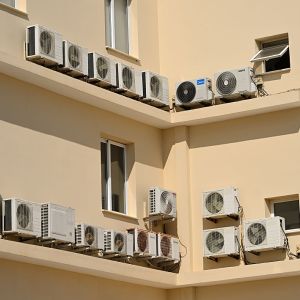
As the world gets hotter, air conditioning (AC) seems like the best way to stay cool. However, it might also make our climate situation worse. A recent study in Nature Communications predicts that by 2050, the use of air conditioning will more than double. This will likely result in significantly higher greenhouse gas emissions, especially as more people in developing countries gain access to AC.
Currently, regions like South Asia and Africa, which face the greatest temperature increases, have the least access to AC. In contrast, places like Europe and North America, with milder climates, use a lot more air conditioning. This disparity creates a troubling cycle. As access to AC spreads, so too could the global temperature by an additional 0.05°C.
Hongzhi Zhang, a researcher at the Beijing Institute of Technology, highlights that if low-income areas gain the same access to AC as wealthier regions, global emissions could soar. Hydrofluorocarbon refrigerants in AC systems are particularly harmful, contributing about 7% of global emissions, according to the U.N.
Despite its climate impact, reliance on AC is growing. The number of residential AC units has tripled since 2000, with over 1.5 billion in 2022. By 2030, more than 45% of the global population is expected to own a unit—up from 37% in 2023. The International Energy Agency (IEA) notes this rise in demand will lead to even higher electricity use and emissions.
Researchers used climate science, energy modelling, and inequality analysis to predict future AC demand based on rising temperatures and changing population dynamics. They explored various scenarios, emphasizing that simply relying on AC isn’t a viable long-term solution.
Experts recommend moving towards cleaner cooling technologies and finding alternative strategies, like better building insulation and shading. Changing personal behaviors, such as reducing AC use during peak hours, can also help.
Yuli Shan, a professor of climate change at the University of Birmingham, stresses that we risk creating an “arms race.” If we don’t act quickly and equitably, our fight against heat could worsen the climate crisis. It’s vital to ensure that vulnerable populations have access to efficient cooling solutions while minimizing environmental damage.
For more insights into cooling technologies and their impact, check out this report from the International Energy Agency.
Source link
greenhouse gas emissions, air-conditioning, global temperatures, Nature Communications, global emissions, rising temperatures, temperatures rise
