
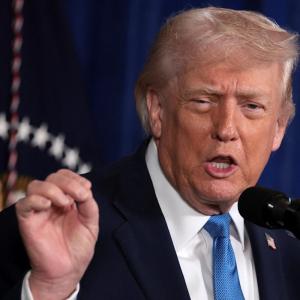
President Trump is heading to the World Economic Forum in Davos, Switzerland. His recent threats to impose tariffs on European countries have stirred up controversy, especially around his interest in Greenland. He believes Greenland is crucial for both U.S. and world security, stating, “There can be no going back — On that, everyone agrees!”
As he arrives in Europe, he’s expected to meet with leaders who are upset about his pursuit of this territory, which belongs to Denmark, a NATO ally. Trump remains optimistic, telling reporters, “Things are going to work out pretty well,” though he hinted he might take strong actions regarding the island.
Over the weekend, Trump announced plans to impose 10% tariffs on goods from eight European nations—Denmark, Norway, Sweden, France, Germany, the UK, the Netherlands, and Finland. If no agreement is reached by June 1, those tariffs could rise to 25%. He’s even threatened a staggering 200% tariff on French wine and champagne after France’s President, Emmanuel Macron, declined his invitation to join a peace initiative.
Recent discussions in EU capitals reveal plans to impose tariffs of up to $108 billion on U.S. products in response. Despite this, Trump claims his actions regarding Greenland won’t alter the EU’s trade agreements with the U.S.
Interestingly, in a letter to the Norwegian Prime Minister, Trump linked his desire to buy Greenland to his feelings about not winning the Nobel Peace Prize, stating, “I no longer feel an obligation to think purely of Peace.”
The U.S. Supreme Court has yet to rule on the legality of Trump’s global tariffs, and the uncertainty continues. Trump has voiced worries that losing tariff authority could be detrimental to the U.S. economy.
According to a recent poll, many Americans are concerned about escalating tariffs and their impact on consumer prices. It’s evident that this situation is not just a political issue; it’s one that directly affects everyday people.
For a fuller understanding of tariffs and their effects, you can check more on global trade policies.
As these developments unfold, they signal a complex intersection of politics, economics, and international relations, highlighting how connected our world truly is.
Source link
President Trump, Greenland
