
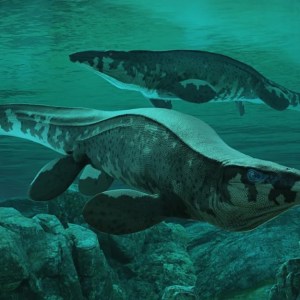
What do you think of when you hear “T. rex”? Most likely, you picture the fierce dinosaur. But there’s a new contender for the T. rex title—this time from the ocean.
Paleontologists recently discovered a massive sea lizard named Tylosaurus rex, which translates to “king of the Tylosaurs.” This creature swam through ancient oceans about 80 million years ago and could grow to a staggering 43 feet long, roughly the size of a humpback whale. It’s a giant among mosasaurs, a group of large, aquatic reptiles.
“This animal truly deserves the title,” says Amelia Zietlow, a paleontologist who helped unveil this discovery. Her team’s research provides fresh insights into how these enormous sea lizards evolved and thrived. They published their findings in the Bulletin of the American Museum of Natural History.
Experts like Tiago Simões from Princeton University are excited about this discovery. He notes that it emphasizes the significance of tylosaurs as one of the largest groups within the mosasaurs. His enthusiasm is echoed by the growing body of research around these creatures.
Zietlow and her colleagues re-evaluated existing data on mosasaurs, gathering measurements from around 300 specimens. They found that the largest ones shared unique skeletal features, including bigger jaws and sharper teeth. This analysis helps highlight differences between T. rex (the sea creature) and its smaller relative, T. proriger, which only reached about 30 feet in length.
Interestingly, this isn’t the first time “T. rex” has been used playfully in paleontology. Back in 2001, scientists named an extinct beetle Tyrannasorus rex. While the name might prompt some confusion, Tom Holtz from the University of Maryland reassures us that since land-dwelling and aquatic animals don’t share habitats, confusion is unlikely.
The discovery also draws comparisons to similar sea creatures. For instance, researchers recently discussed fossils of a killer whale-like predator called Ichthyotitan, which existed in the same time frame. This points to the diverse range of marine life that once roamed our oceans.
The introduction of Tylosaurus rex has sparked interest both within the scientific community and among dinosaur enthusiasts. As discussions about ancient sea monsters grow, social media is buzzing with excitement over the discovery, showcasing memes and educational posts about this giant.
So, while we may think of the fierce T. rex on land, we now have an equally fearsome counterpart lurking in the depths of our prehistoric oceans. Both remind us of the incredible diversity of life that once existed on our planet, and there are still many wonders yet to be uncovered.
For more on ancient marine life, check out the National Geographic for fascinating discoveries about sea life from the past.
Source link
Tyrannosaurus rex, Amelia Zietlow, paleontologists, Mike Polcyn, Tylosaurus, Zietlow
