
Astronomers analyzing data from the James Webb Space Telescope think they may have found the universe’s oldest black hole, possibly formed less than a second after the Big Bang. Their research, detailed in a new study awaiting peer review, hints at the existence of a primordial black hole—a type that has puzzled scientists for years.
Unlike typical black holes, which usually form from the collapse of massive stars, primordial black holes might have emerged in the universe’s earliest moments. This means they could be much smaller, maybe even the size of a planet or an atom. Roberto Maiolino, a cosmologist at Cambridge, explained that this discovery challenges our existing theories, as it appears this black hole formed without being surrounded by a galaxy.
While their findings are impressive, Andrew Pontzen from the University of Durham warns it’s too soon to declare this evidence definitive. The black hole might be about 700 million years old—far after the universe’s birth but still ancient in astronomical terms. The team uses fresh observations from the James Webb to bolster their claim, but Pontzen notes that it’s still an indirect argument and more research will be needed to resolve the issue.
Historically, black hole formation has been seen as a result of massive objects collapsing. However, recent discoveries reveal black holes that are too large and ancient to have formed in the usual way. This has led astronomers to explore other possibilities, including the idea that they might arise from the direct collapse of dense gas clouds influenced by dark matter.
Primordial black holes are particularly fascinating because they could have formed shortly after the Big Bang, in conditions where matter was still unevenly distributed. This early formation could help explain some ancient black holes’ size, as they would have had a head start in accumulating mass. There’s also speculation that they might be linked to dark matter, potentially trapping vast amounts of undetectable matter.
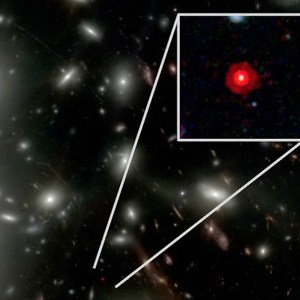
The latest candidate for a primordial black hole is identified as QSO1, a small red dot seen by the James Webb. Its faintness makes it difficult to analyze fully, but leading theories suggest it’s either a compact galaxy or an active supermassive black hole. However, as the researchers looked closer, they found little evidence of a surrounding galaxy, raising questions about its formation.
Using gravitational lensing, a technique that uses the gravity of nearby massive objects to magnify distant ones, insight into the black hole’s mass was gained. It’s estimated to have around 50 million solar masses—strikingly heavier than what we typically see in local galaxies.
Maiolino has noted that the matter around this black hole consists of only hydrogen and helium, the very first elements formed in the universe. No heavier elements are detected, suggesting this black hole resides in a barren region without a substantial galactic structure.
While there isn’t conclusive proof of primordial black holes yet, ongoing work in this field is revealing new possibilities in understanding cosmic origins. Experts predict that advancements in gravitational wave detection over the next decade could provide more clarity on these fascinating celestial phenomena.
For more detailed exploration of black holes, you can read about how black holes could form inside planets, leading to unprecedented consequences.
Source link
black hole, primordial black hole, supermassive black holes, Andrew Pontzen, Roberto Maiolino, stars and galaxies
