
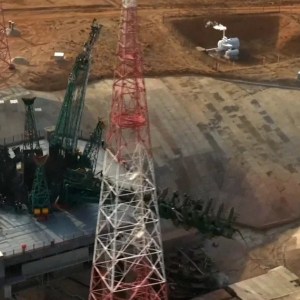
The Baikonur Cosmodrome, Russia’s main launch site in Kazakhstan, recently faced a major setback. A failed Soyuz launch caused considerable damage to the launch pad. While the Soyuz MS-28 mission was successful and the crew reached the International Space Station (ISS) safely, the site itself was severely impacted.
Drone images revealed the mobile maintenance cabin turned upside down within the flame trench of the launch pad. Experts suggest repairs could take months or even years. This situation is worrying, as Baikonur is Russia’s only certified launch site for crewed missions.
NASA has acknowledged the incident and is closely working with Roscosmos, Russia’s space agency. Despite current tensions between the U.S. and Russia, NASA has stated it coordinates with Roscosmos to ensure safe operations at the ISS. The accessibility of crewed flights is limited. Apart from Russia’s Soyuz spacecraft, SpaceX’s Dragon is currently the only other option for transporting astronauts.
According to a NASA spokesperson, they are aware of the damage and are monitoring the situation. Although the MS-28 crew is safe, it’s uncertain how this will affect future missions. Roscosmos confirmed the launch pad damage and stated they have the necessary parts to restore it, emphasizing that repairs would happen quickly. However, given the complexities of space missions, actual timelines may vary.
This incident could disrupt upcoming ISS operations. A resupply mission set for December has already been postponed to next year, and the next crewed Soyuz launch is now planned for July 2026.
The relationship between Russia and the ISS has been tenuous, especially after the invasion of Ukraine strained political ties. However, in late 2024, former Roscosmos head Yuri Borisov confirmed Russia’s commitment to ISS operations until at least 2028, a change from prior threats to withdraw support.
Jeff Manber from Voyager Technologies raised an important question: “How serious is Russia about fixing the launch pad and supporting the ISS program?” His concern reflects the uncertainty surrounding future collaborations in space.
As we see shifting dynamics in international space missions, it’s crucial for the space community to pay attention to how countries adapt to these changes. The future of crewed spaceflight, particularly for the ISS, hangs in the balance.
For more details, you can read about the incident on Yahoo News.
Source link
NASA, Baikonur Cosmodrome, Russia, International Space Station, Roscosmos, Christopher Williams
