
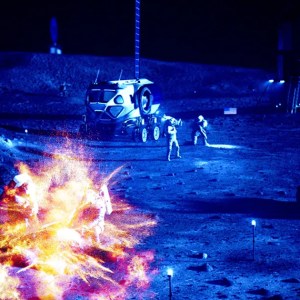
NASA scientists are diving deeper into how fire acts in space, especially on the Moon. They’ve already tested small, controlled flames aboard the Northrop Grumman Cygnus spacecraft, studying flame-retardant materials and fire’s behavior without Earth’s gravity.
Now, with plans to establish a permanent presence on the Moon, NASA is set to explore how materials might catch fire on the lunar surface. This research is part of the Flammability of Materials on the Moon (FM2) project. They are questioning existing safety tests, like the NASA-STD-6001B standard, which evaluates materials under Earth’s gravity. This test uses a six-inch flame to see if a material burns significantly or drips burning debris. If it fails, it’s deemed unsafe for space use.
However, the team points out a key issue: these tests take place on Earth, and we can’t assume that materials that pass in 1G will be safe on the Moon. The Moon’s partial gravity could change everything. If a fire breaks out inside a lunar habitat or spacecraft, it could quickly become dangerous.
Interestingly, materials that seem only slightly non-flammable on Earth could easily ignite on the Moon. This happens because of a phenomenon called blowoff, which allows flames on Earth to thrive on fresh oxygen. In lunar gravity, this process might not work the same way, allowing fires to burn more easily.
Research using drop towers and sounding rockets indicates that some materials might actually become more flammable in low gravity. Moreover, lunar habitats may have oxygen-rich environments to help astronauts breathe, but they could also fuel fires.
To get more precise data, NASA plans to conduct experiments with four solid fuel samples in simulated lunar atmospheres, aiming for a launch in late 2026. This initiative will include cameras and sensors to capture how fire behaves over a longer period.
Understanding fire’s behavior on the Moon is vital for astronaut safety. If materials that are safe on Earth turn out to be dangerous on the Moon, it could have serious implications for future missions.
Now, let’s take a quick look back at space exploration history. During the Apollo missions, fire safety was a significant concern. The tragic Apollo 1 incident highlighted just how critical fire management is in closed environments.
These upcoming tests could provide essential insights, creating a safer future for astronauts venturing into deep space. As we prepare for longer missions on the Moon and Mars, the nature of fire will be a key focus.
For further insights on fire safety and past space incidents, read more from authoritative sources like NASA’s reports on spacecraft fire concerns.
Source link
NASA scientists, lunar surface, flame retardant materials, Earth’s gravity, standardized test, test
