
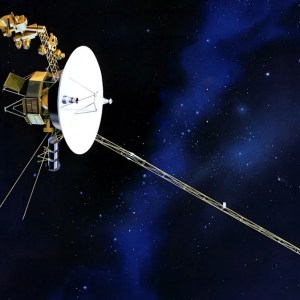
Nothing manmade has traveled farther from Earth than the Voyager spacecraft. Launched in 1977, Voyager 1 and Voyager 2 are zooming away from the Sun at 38,000 miles per hour. They’ve now journeyed over 12 billion miles. By the end of this month, Voyager 1 will be a light-day away from us.
Initially, these twin spacecraft set out to explore the outer planets of our solar system. But they’ve taken on a new role as messengers of humanity, venturing into the far reaches of space. Over the years, their mission has faced challenges. NASA has had to turn off some instruments and even revive systems that haven’t been used in decades to keep the probes operational. Despite this, the Voyagers continue their mission, expanding our understanding of the universe beyond the solar system.
Years ago, both spacecraft encountered a startling “wall of fire” at the edge of our solar system, where temperatures soared to an astonishing 90,000 degrees Fahrenheit. This boundary marks the edge of the heliosphere, a concept scientists had theorized about long before the probes launched.
The heliosphere acts like a bubble, with our solar system nestled inside. It forms from solar wind—charged particles emitted by the Sun’s atmosphere. The outer layer meets the interstellar medium, which contains gas, dust, and other materials between stars.
Historically, researchers in the late 1950s and early 1960s established that these solar winds exist. However, it wasn’t until Voyager 1 reached the heliopause in 2012 that we learned just where the solar wind ends. Voyager 2 followed suit in 2018, confirming theories about the non-spherical shape of the heliosphere.
Scientists expected that the heliosphere would expand and contract like a lung based on solar activity. This proved true when Voyager 1 and 2 arrived at this boundary at different times and speeds. Surprisingly, the heliosphere resembles a teardrop rather than a round bubble, as our solar system moves through space, creating a bow shock—much like a boat moving through water.
At the edge of our solar system, the heat recorded by the Voyagers has been immense, ranging from 54,000 to 90,000 degrees. Such extreme temperatures serve as a reminder of the powerful forces at play in our universe.
The ongoing journey of Voyager 1 and 2 is not just fascinating but also invaluable for science. As we gather more data, we gain insights that could reshape our understanding of both our solar system and interstellar space.
For more details on their incredible journey, check out NASA’s comprehensive resources on the Voyager missions.
Source link
Voyager spacecraft, solar system, heliosphere, Voyager 1
