
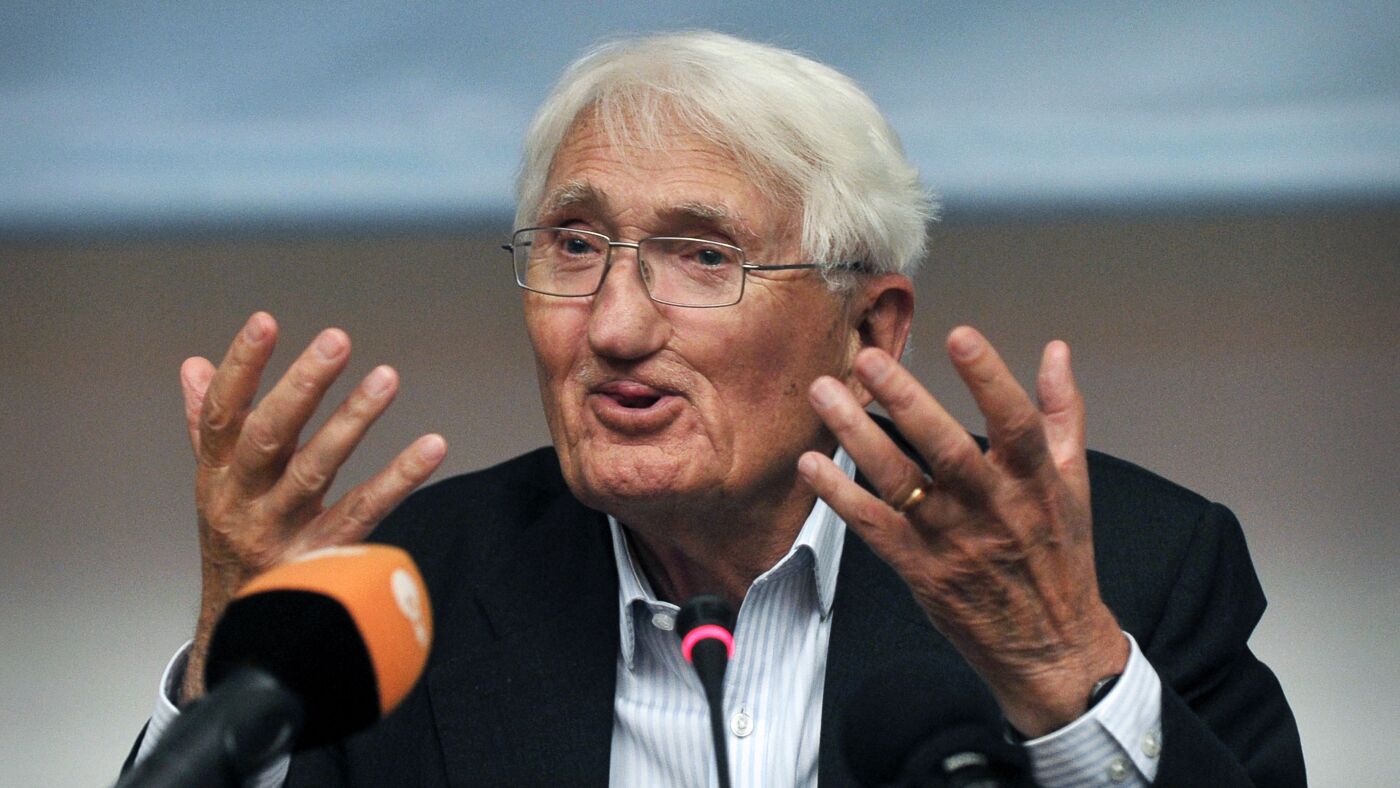
Jürgen Habermas, a leading German philosopher, passed away on Saturday in Starnberg, Germany, at the age of 96. His death was confirmed by Suhrkamp Verlag, his publisher, highlighting his significant impact on modern philosophy and political discourse.
For over 60 years, Habermas shaped conversations around democracy in Germany, especially during pivotal historical moments like the postwar and post-reunification periods. He was famous for introducing the idea of the “public sphere,” which emphasizes the need for open public discussions free from government control—a cornerstone of healthy democracy.
“Germany and Europe have lost one of the most significant thinkers of our time,” remarked German Chancellor Friedrich Merz.
Habermas gained attention as a key figure in the Frankfurt School. This group critically examined capitalism, fascism, and Marxism, and offered insights on how Germany should reckon with its Nazi past. Habermas believed that acknowledging this history is crucial for the country’s democratic future.
Born in 1929 in Düsseldorf, Habermas lived through World War II, which deeply influenced his worldview. He joined the Hitler Youth as a child but later became a vocal critic of the Nazi regime. After the war, he explored philosophy and other fields at universities in Göttingen, Zurich, and Bonn. During this time, he challenged figures like Martin Heidegger for their troubling views on Nazism.
Matthew Specter, an intellectual historian, described him as “a modern-day Aristotle.” Habermas taught the value of reasoning and the importance of learning from past mistakes. His work continues to serve as a resource against rising authoritarianism today.
His books and lectures were known for their depth. Habermas held teaching positions at prestigious institutions, including the Universities of Heidelberg and California, Berkeley. His groundbreaking work, “Theory of Communicative Action,” published in 1981, is considered a pivotal text in critical theory.
Former Georgetown University president John DeGioia acknowledged Habermas’s ability to engage across multiple disciplines, becoming a respected voice in political theory, sociology, and legal theory, among others.
Among many honors, he received the Erasmus Prize in 2013 for his outstanding contributions to European culture and social science. Yet, his ideas were not without criticism. Some scholars argue that his views on communication fail to account for real-world power dynamics.
Despite facing critiques, Habermas remained hopeful about democracy. He believed that people’s faith in the future is essential for maintaining democratic ideals. In a 2010 article for The New York Times, he noted, “Democracy depends on the belief of the people that there is some scope left for collectively shaping a challenging future.”
His legacy continues to inspire conversations about democracy, communication, and the importance of public discourse. For those interested in exploring more about the impact of Habermas’s work, check out [the Suhrkamp statement](https://www.suhrkamp.de/trauermeldung/zum-tod-von-juergen-habermas-b-5025) and [his 2010 article](https://www.nytimes.com/2010/10/29/opinion/29Habermas.html) in The New York Times.
