
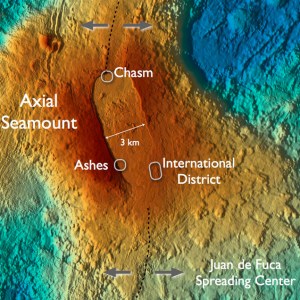
An underwater volcano off the Oregon coast, known as the Axial Seamount, is being carefully watched by scientists. They say it’s not likely to erupt anytime soon, despite earlier predictions.
The Axial Seamount sits about 300 miles offshore and lies nearly 5,000 feet deep in the Pacific Ocean. To give you an idea of its depth, it’s about two and a half times taller than One World Trade Center in New York City.
This volcano is quite active. In the past 30 years, it has erupted three times: in 1998, 2011, and 2015. Experts like Bill Chadwick from Oregon State University and Scott Nooner from the University of North Carolina are keeping tabs on it. Chadwick recently mentioned, “Our forecast of an eruption at Axial Seamount by the end of the year still stands, but nothing looks imminent.”
Is There a Threat?
You might be wondering if an eruption would pose a risk. Fortunately, the answer is no. The great depth of the Axial Seamount, along with its gentle lava flows, means it won’t threaten people, ships, or property. Chadwick has pointed out that “if you were on top of it on a boat, you would never know it.”
These eruptions offer scientists valuable insights into volcanic behavior both underwater and on land.
What’s Happening with the Volcano?
Why was there a prediction for an eruption this year? Scientists watch for signs like inflation. This happens when magma builds up beneath the seabed, pushing the surface upwards. There were signs in January that Axial Seamount had inflated to levels similar to those seen before its past eruptions.
However, as of July, the rate of inflation has been decreasing, which is a good sign. Researchers also track seismic activity near the volcano. In June alone, over 2,000 earthquakes were recorded in a single day near Axial Seamount, hinting that it may still be restless.
In fact, a recent tsunami wave from a large earthquake near Russia’s Kamchatka Peninsula triggered automatic alerts, even though there wasn’t an eruption.
Chadwick noted that the situation remains unpredictable. “We can only wait and see, but nothing seems imminent at the moment,” he explained. Scientists hope that by monitoring the current activity, they can learn more about what it takes to trigger an eruption.
New Insights
Recent research indicates that underwater volcanoes like the Axial Seamount play a key role in influencing marine ecosystems. A 2022 study published in Marine Ecology Progress Series found that volcanic eruptions can enrich ocean waters with nutrients, which in turn supports the growth of marine life.
In social media circles, there’s been an increasing interest in volcanoes, especially as more people turn to nature and geology for relaxation and learning. Hashtags like #UnderwaterVolcanoes have gained popularity, drawing attention to the mysteries of these underwater giants.
In short, while the Axial Seamount is active, it does not pose a significant threat to the surrounding area. Continued monitoring helps scientists learn more about volcanic behavior and marine ecosystems, contributing to our understanding of the natural world.
Source link
Underwater volcano, Bill Chadwick, Axial Seamount, coast of Oregon, U.S. Geological Survey, National Science Foundation, Oregon State University
