
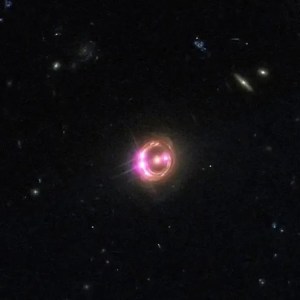
Black holes are often seen as mysterious and hidden, but recent discoveries are shedding light on their surroundings. In a fascinating study, astronomers have managed to measure the elusive “corona” around a supermassive black hole named RX J1131, located about 6 billion light-years from Earth.
This black hole spins at over half the speed of light and feeds on gas and dust, creating a quasar—one of the brightest objects in the universe. The corona, a halo of extremely hot gas, spans approximately 50 astronomical units, which is about the same size as our solar system.
A key breakthrough happened when scientists observed a cosmic alignment involving a foreground galaxy about 4 billion light-years away. The immense gravity of this galaxy acted like a lens, allowing researchers to get a clearer view of the black hole’s corona.
“This is the first time such a measurement has been made,” said Matus Rybak, a senior researcher at Leiden University who led the study. This new method gives astronomers fresh insights into the behaviors near black holes that traditional telescopes can’t capture.
During their research, the team examined data collected by the Atacama Large Millimeter/submillimeter Array (ALMA) telescope. They noticed unusual flickers in brightness among images of RX J1131. Unlike other astronomical phenomena, these flickers didn’t occur simultaneously, suggesting that individual stars in the foreground galaxy were briefly magnifying different regions of the corona.
“This flickering was something we couldn’t explain otherwise,” Rybak noted. Understanding these changes allows the team to measure the size of the corona directly, transforming RX J1131 into an invaluable cosmic laboratory.
Additionally, this breakthrough could help scientists learn more about the magnetic fields surrounding black holes. Strong magnetic fields influence how gas falls into a black hole and how much is expelled, essentially dictating how these massive cosmic objects grow over time. However, measuring these fields directly has always been a challenge.
Previous research indicates a possible connection between the corona’s emissions and the strength of these magnetic fields. This relationship could be vital for understanding black hole dynamics.
Interestingly, the study revealed that changes in the corona could happen much quicker than once believed. This challenges previous assumptions about the stability of millimeter-wave light emissions, prompting astronomers to re-evaluate what they thought they knew.
As technology advances, tools like the Vera C. Rubin Observatory will enable even more precise measurements. This telescope will help astronomers discover thousands of lensed quasars, opening doors to new findings in the study of black holes.
With each discovery, we get closer to unraveling the mysteries of these cosmic giants. There’s still so much more we don’t know, and it’s this uncertainty that makes black hole research incredibly exciting.
For more information on black holes and recent cosmic research, you can check out NASA or read the study published in Astronomy & Astrophysics here.
Source link
black hole, distinct images, supermassive black hole, Matus Rybak, foreground galaxy, Live Science, solar system, astronomers, measurement
