
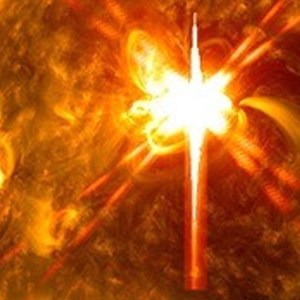
The Sun has been very active lately, sending out four significant solar flares that could lead to an exciting week in space weather. It all started on February 1, at 12:33 UTC, when an X1.0 flare was recorded. Just 11 hours later, a powerful X8.1 flare erupted. Then, on February 2, we saw two more flares, one at X2.8 and another at X1.6.
X-class flares are the strongest types the Sun can create. The X8.1 flare was especially noteworthy; it was the most powerful since October 2024 and ranks as the 19th-strongest flare ever recorded. These flares came from a group of sunspots labeled RGN 4366, which has just begun to face Earth, according to NOAA’s Space Weather Prediction Center.
Experts warn that if this sunspot continues to evolve and become more complex, we could see more intense solar activity. This could lead to energetic particles or even coronal mass ejections (CMEs). CMEs are massive bursts of plasma that can have both beautiful and disruptive effects on our planet. They create stunning auroras but can also cause issues with satellites and power grids.
Historically, solar storms have had significant impacts on Earth. The most violent solar storm, recorded in 12350 BCE, was so intense it altered the planet’s magnetic field. Now, as we are nearing the end of an active solar cycle that peaked in 2024, forecasters are seeing an uptick in solar activity.
A recent survey from the University of Michigan indicated that 60% of Americans are aware of solar flares and their potential effects, reflecting a growing interest in solar weather. Social media has also been buzzing with hashtags like #SolarFlares, as users share photos of auroras and discuss the implications of these solar events.
As we continue to monitor the Sun, it’s clear that while activity might start to wind down, there are still wild space weather events on the horizon. Keep an eye out; the Sun has more surprises in store!
For a deeper dive into solar phenomena, you can refer to the NOAA Space Weather Prediction Center.
Source link
solar flares, The Sun, Space Weather Prediction Center, Solar Dynamics Observatory
