
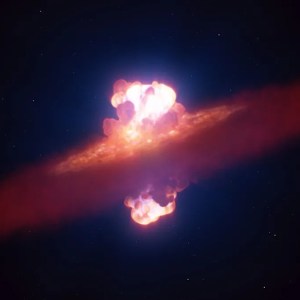
A supernova is a spectacular explosion marking the death of a massive star. Recently, astronomers witnessed a significant supernova event, named SN 2024ggi, located about 22 million light-years away in the constellation Hydra. This explosion was spotted by the Asteroid Terrestrial-impact Last Alert System (ATLAS) on April 10, 2024. Just a day later, researchers at the Very Large Telescope (VLT) in Chile captured its early moments.
What makes SN 2024ggi intriguing is the way it exploded. Traditionally, we thought that supernovae exploded in perfect spheres. However, this one revealed a different shape. Using spectropolarimetry—a technique that analyzes light waves—scientists found the initial shock of the explosion stretched like an olive rather than expanding evenly. This insight may change our understanding of how these massive stars die.
When a massive star runs out of fuel, gravity takes over, causing the star’s core to collapse under its own weight. This collapse triggers a shock wave that sends out energy, resulting in a brilliant explosion. For a brief moment after the explosion, before it disrupts its surroundings, astronomers can observe its breakout shape. In the case of SN 2024ggi, the VLT’s unique instruments offered this unprecedented look.
As the supernova expanded, its light started interacting with the surrounding gas, revealing more layers of the star. About ten days after the explosion, astronomers observed hydrogen-rich layers aligning with the earlier shock, suggesting the explosion maintained a consistent shape from the start. This discovery helps scientists refine existing models of supernovae and may lead to new theories.
Experts in astrophysics emphasize the importance of such observations. Dr. Michelle Turner, an astrophysicist known for her work on supernovae, stated, “Understanding these explosions helps us learn about the life cycles of stars and the evolution of galaxies.” Her insights highlight how each supernova provides valuable data that can change what we know about the cosmos.
Recent studies suggest supernovae are not only crucial for understanding star life but also play a role in seeding the universe with essential elements. Every explosion disperses elements like iron and carbon, which are vital for forming planets and life as we know it. In fact, a 2022 survey of star formations indicated that supernova events are linked to about 70% of the heavy elements in the universe.
The study of SN 2024ggi, published in Science Advances, may offer clues about the dynamics of supernovae and refine our theoretical frameworks. As more data becomes available, scientists continue to unveil the complex nature of these deep-space phenomena, shaping our understanding of the universe’s history and chemistry.
For anyone captivated by the universe’s wonders, keeping an eye on such discoveries is essential. The cosmos holds many secrets, and each new finding brings us closer to understanding our place within it.
Source link
supernova, stars, spherical shape
