
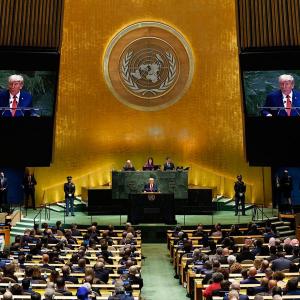
As leaders gather in New York for the UN General Assembly and Climate Week, two very different worlds collide. On one side are wealthy nations that prioritize climate change. On the other, developing countries focused on urgent issues like poverty, hunger, and disease.
For decades, both sides have struggled to find common ground. Despite the enormous money spent on climate policies—over $14 trillion since the 1992 Rio Earth Summit—the benefits have been minimal. The renewable energy share only rose from 12% to 14%. At this pace, we might need four centuries to fully transition to renewable energy. The UN has noted that even if all climate pledges are met, emissions could still be 19% higher by 2030 compared to 2019 levels. Yet, more grand promises are likely to emerge without addressing their significant economic costs and minor climate effects.
In 2022 alone, the world spent over $2 trillion on climate policies. Projecting forward, achieving net-zero emissions by 2050 could cost an unimaginable $27 trillion annually for the rest of the century. This unsustainable spending poses a threat to economic growth and escalates energy costs, most affecting those living in poverty. Strikingly, for each dollar invested in these climate policies, only about 17 cents in benefits are generated.
Consider a different approach: investing a fraction of this money could save millions of lives. For example, a simple neonatal resuscitation intervention costs just $5 and could prevent countless maternal and infant deaths. In fact, with a $2.1 billion investment, we could avert 166,000 maternal and 1.2 million infant deaths each year. This spending could yield social returns of $87 for every dollar spent.
There’s plenty more we could accomplish with targeted investments. For $1.7 billion, we could expand vaccinations, potentially saving 500,000 children annually. Another $1.1 billion could tackle malaria, preventing 200,000 deaths while returning $48 for every dollar spent. Similarly, $5.5 billion in agricultural research could improve food production for 100 million people.
Unlike climate policies with their astronomical costs and inconsequential outcomes, these targeted interventions promise significant gains for far less money. However, the focus remains on lofty climate goals that may end up being economically unrealistic. If developed nations continue to shoulder the burden of net-zero pledges, individuals could see costs ranging from $5,000 to $20,000 per person annually—something that seems unattainable for many.
Historically, climate activists have often painted a dire picture, shouting that time is running out. Yet, research reveals a different narrative. Studies show that unchecked climate change may only reduce global GDP by 2-3% by mid-century—far from apocalyptic.
The real solution to climate issues lies in advancing energy innovation rather than making energy costlier and less reliable. Increasing funding for green research and development can lead to breakthroughs that make green energy more affordable and accessible for everyone, including those in poorer nations who desperately need it.
The key question remains: should we prioritize efficient policies that tackle hunger, disease, and poverty first, or cater to the climate concerns of the richest? The upcoming Climate Week may focus on ambitious but unattainable goals, forgetting the pressing needs of developing nations.
After 30 years of emphasizing climate to the detriment of other vital issues, it’s time for a shift in priorities. The world’s poor need immediate access to healthcare, nutrition, and growth opportunities, not more ineffective climate promises.
Bjorn Lomborg, President of the Copenhagen Consensus and a voice in this discussion, calls for a pivot. Resources should be funneled into effective solutions that combat humanity’s most pressing challenges, rather than engaging in inefficient climate theatrics.
For further insights, you can explore the 2024 Emissions Gap Report and research on the effectiveness of targeted health interventions.
Source link
climate change, climate policies, United Nations General Assembly, billions of dollars, global energy, UN headquarters, New York, developing nations, New York City
