
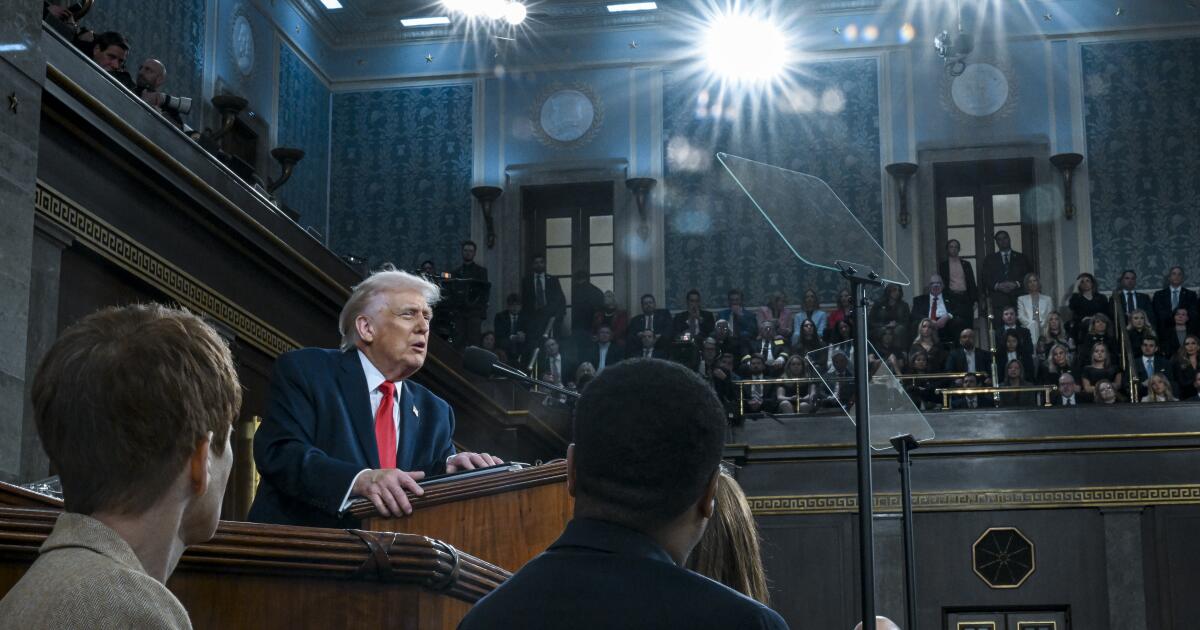
Over 32.6 million people tuned in to watch President Trump’s State of the Union address. This was his first speech to Congress during his second term, and it marked the smallest audience for such an event since he took office. Previously, his speeches attracted even more viewers: 45.5 million in 2018, 46.8 million in 2019, and 37.1 million in 2020.
This year’s address was also the longest in recent memory, lasting a full 107 minutes—surpassing President Clinton’s record of 105 minutes set in 2000. Despite facing lower approval ratings, Trump highlighted positive economic figures, though some were later pointed out as exaggerated, leading to mixed reactions from members of Congress.
He also gave a nod to the U.S. Olympic men’s hockey team, celebrating their gold medal win, and recognized several guests, including the widow of activist Charlie Kirk and Paramount Skydance CEO David Ellison.
In terms of viewership, 15 networks aired the speech. Fox News led the pack with 9.1 million viewers, followed by ABC, NBC, CBS, and CNN.
Why Does This Matter?
Media analysts suggest that dwindling numbers for such speeches reflect broader trends in how people consume news today. With many turning to social media for updates, traditional broadcasts struggle to engage larger audiences. According to a recent survey, over 60% of Americans prefer to get news from online platforms rather than traditional TV channels.
In a historical context, the decline in viewership could be seen as part of a long-term trend. In the early 2000s, viewership for these addresses often reached upwards of 40 million. As viewing habits evolve, it’s likely that future leaders will need to adapt their communication strategies to engage a changing audience.
Social media reactions often provide immediate feedback on presidential addresses. During the speech, comments flooded platforms like Twitter, with many expressing strong opinions, both in support of and against the president’s claims. This trend indicates how modern communication has transformed political discourse, influencing public perception almost in real-time.
For further insights on media consumption trends, the Pew Research Center offers extensive data on how audiences engage with political events. Pew Research Center Analysis.
