
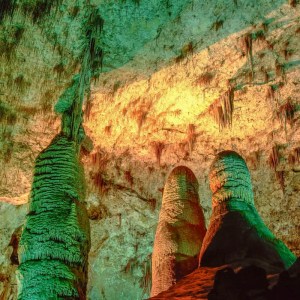
Microbes are surprising little creatures. Recently, scientists discovered that some in a New Mexico cave can thrive without any sunlight at all. Instead of visible light, they use near-infrared light, which is invisible to the human eye.
Hazel Barton, a geology professor at the University of Alabama, and Lars Behrendt, a microbial biologist from Uppsala University, explored the Carlsbad Caverns in 2018. Deep in a section far from tourists, they found bright green cyanobacteria covering the cave walls. These tiny organisms use special forms of chlorophyll, known as chlorophyll d and f, to absorb light that scientists previously didn’t consider.
Remarkably, in areas of the cave with no visible light, researchers found near-infrared light levels nearly 700 times higher than at the entrance. The largest colonies of cyanobacteria were located in these deeper, darker spots. When the team sampled other caves in the national park, they discovered similar light-harvesting bacteria in each one.
This finding could change how scientists look for life on other planets. Many stars, especially red dwarfs, emit mostly near-infrared light. This means life might exist in places we never imagined. Barton and Behrendt have even suggested a NASA project aimed at exploring how little light these microbes need to survive. Such information could help scientists narrow down planets to investigate using the James Webb Space Telescope.
The implications are exciting. If these bacteria can live in total darkness for millions of years, what else might be out there? Oxygen is tough to produce in an atmosphere without the presence of life. So, finding oxygen on distant planets could be a strong sign of potential life.
“What we’ve shown is that life can thrive in realms we didn’t expect, like deep caves in New Mexico,” Behrendt noted. This discovery not only broadens where we can search but ignites a thrilling curiosity about the universe and its secrets.
These insights remind us that life is resilient, capable of surviving in extreme conditions. So, next time you gaze at the stars, you might wonder: where else could life exist? The answer might be more far-reaching than we thought.
Source link
Lars Behrendt, Hazel Barton, Uppsala University, Carlsbad Caverns, cyanobacteria, visible light, University of Alabama, invisible light
