
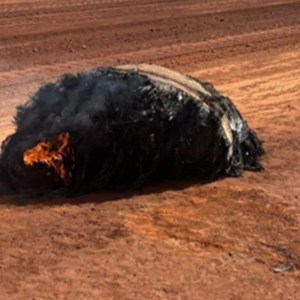
Mine workers in Western Australia recently stumbled upon a burning piece of metal, thought to be part of a Chinese space rocket. This unusual find occurred about 19 miles east of Newman on October 18. Local police and other authorities quickly arrived to assess the scene and identify the object.
Experts have confirmed that the debris is made of carbon fiber, a lightweight yet strong material often used in spacecraft due to its resistance to heat. “It was burning when it was found, which is not typical for space debris,” noted Marco Langbroek, an astrodynamics expert. The Australian Transport Safety Bureau ruled it out as a crashed aircraft, while the Australian Space Agency is currently investigating its origins.
Why Space Junk Matters
Space debris is a growing concern. Research shows that about 99% of objects launched into space are still up there. As more rockets and satellites are sent into orbit, the risk of larger pieces returning to Earth increases. For instance, Starlink has over 8,500 satellites in orbit, many of which could potentially fall back to Earth as they degrade.
The sustainability of space activities is crucial. Anncy Thresher, a space policy expert, emphasizes that when heavier pieces of debris come down, they pose risks to both people and property on the ground.
Efforts to Tackle Space Debris
On October 20, the Australian Space Agency stated that the debris likely came from a propellant tank or a similar component of a spacecraft. They’re working with international agencies to pinpoint its exact origin.
A reader on Space.com highlighted the need for accountability from the companies that launch these objects, insisting they should ensure safe return options at the end of a satellite’s life. “With all of the space junk orbiting, it’s just a matter of time before something dangerous lands in a populated area,” the commenter pointed out.
As we dive deeper into space exploration, balancing advancement with safety remains essential. It’s clear that better management of space debris is an urgent issue that demands global attention.
For further insights on space debris and its implications, you can read more at Northeastern Global News and Space.com.
Source link
space debris, Australian Space Agency, space rocket, local authorities, spacecraft structures, Australian Transport Safety Bureau
