
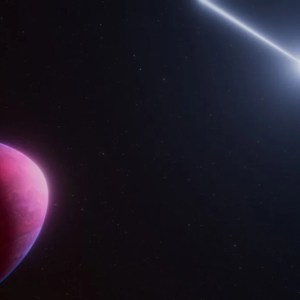
A newly discovered exoplanet, PSR J2322-2650b, has left scientists scratching their heads. Detected by the James Webb Space Telescope (JWST), this massive, Jupiter-like planet sports an atmosphere unlike anything we know in our solar system. Instead of the usual gases like helium, hydrogen, or water, it features clouds of soot that might form diamonds deeper down.
“This was an absolute surprise,” says Peter Gao, a researcher at the Carnegie Earth and Planets Laboratory. The team’s initial reaction was sheer disbelief: “What the heck is this?” They found this unusual atmosphere puzzling. Not only is the composition strange, but the planet also orbits a neutron star, or pulsar—a type of supernova remnant that emits regular bursts of radiation.
PSR J2322-2650b’s unique characteristics pose many questions. It orbits its pulsar extremely closely, at just about one million miles away, which is nearly 100 times closer than Earth is to the Sun. This rapid orbit takes only 7.8 hours, and gravity from the pulsar distorts the planet’s shape into a lemon-like form. Most gas giants in our solar system, like Jupiter, are found far away from their stars.
The discovery was unveiled in research published in *The Astrophysical Journal Letters*. Interestingly, JWST couldn’t detect the pulsar itself due to its high-energy gamma rays, allowing researchers to focus solely on the planet instead. “This system is unique because we can study the planet illuminated by its host star, while not seeing the star at all,” says Maya Beleznay, a doctoral physics student at Stanford University. This opens up new opportunities for studying exoplanets.
The planet’s origin remains a mystery. It could share similarities with “black widow” systems, where a pulsar consumes nearby stars. But Michael Zhang, a fellow at the University of Chicago, argues that this explanation doesn’t fit PSR J2322-2650b. Its unexpectedly carbon-rich atmosphere raises doubts about standard formation theories.
Experts have yet to determine how soot or diamonds could exist in such extreme heat. Typically, carbon molecules don’t survive close to their stars, leading to a possibility explored by professor Roger Romani of Stanford. He suggests that after formation, carbon and oxygen might crystallize, but the details remain unclear. “It’s great to have a puzzle to go after,” Romani says. Scientists are excited to further investigate this oddly intriguing atmosphere.
This research sheds light on the never-ending surprises waiting in the cosmos. With each new finding, we inch closer to understanding our universe’s complexities, one bizarre planet at a time. For related discoveries and ongoing updates, you can check out articles from reputable sources like NASA and Science Daily.
Source link
James Webb telescope, host star, Ralf Crawford, atmosphere, our solar system
