
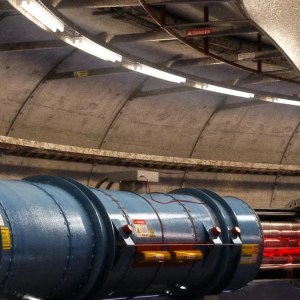
Scientists at CERN and Goethe University have recently revealed an intriguing phenomenon occurring in the Super Proton Synchrotron (SPS): a resonant “ghost.” This discovery is a significant milestone as the SPS is set to celebrate its 50th anniversary in 2026.
So, what exactly is this ghost? It’s linked to resonance, a concept you might relate to when you spill coffee while walking or bounce higher on a trampoline. The SPS, a nearly four-mile circular particle accelerator, uses powerful energy beams that can create complex interactions. When waves of energy resonate, they can amplify at certain points, leading to potential issues like beam degradation.
In a nutshell, beam degradation occurs when the particles inside the accelerator start to lose energy. This is crucial because energized proton beams behave differently. Understanding the ghost’s effects can help scientists minimize these losses in future experiments.
To shed light on the ghost phenomenon, researchers employed a mathematical tool called a Poincaré section. This method creates a sort of dynamic 3D map, allowing scientists to visualize how particles behave over time. Their findings indicate that small fluctuations, like those caused by imperfect magnets, can lead to these resonance issues.
Experts stress that managing these resonances is critical in particle physics. “Understanding resonances and their nonlinear dynamics is essential to avoid losses,” the scientists mentioned in their research. It’s not just about looking at the particles in isolation; they’re part of a complex and interconnected system.
Interestingly, as the SPS celebrates its history, it has evolved significantly. Recent upgrades, like a new beam dump, enhance its capabilities and play a vital role in ongoing research.
Overall, this work could lead to better particle accelerators in the future, preventing the creation of unwanted “ghosts” and allowing for more accurate experiments. With this understanding, researchers are aiming for not just improved performance but also cost savings in research.
If you’re curious about the deep implications of this study, you can read the full findings in the journal Nature Physics here.
Source link
Goethe University Frankfurt, SPS, nuclear fusion research, particles
