
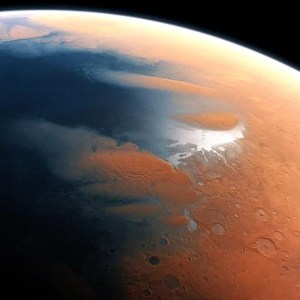
Scientists have long believed that Mars was once covered in water, perhaps with lush landscapes capable of supporting life billions of years ago. Recent research confirms this idea, shedding light on what Mars looked like in its wetter days.
A team of international researchers used satellite data to explore an area called Coprates Chasma, part of Valles Marineris, the largest canyon in our solar system. Their study showed that the canyon’s features resemble river deltas on Earth, suggesting that Mars was once a “blue planet” about three billion years ago.
In a study published in NPJ Space Exploration, the scientists found signs that rivers flowed into a Martian ocean. They inferred that this ocean was vast and possibly comparable in size to the Arctic Ocean. The team examined high-resolution images from Europe’s ExoMars Trace Gas Orbiter and NASA’s Mars Reconnaissance Orbiter, allowing them to analyze the Martian landscape in detail.
Coauthor Ignatius Argadestya noted, “The unique images let us map the Martian terrain, revealing mountains and valleys similar to those on Earth.” He expressed particular excitement about discovering delta shapes near one mountain.
The researchers compared Martian fan deltas—formed when mountain streams deposit sediment into a larger water body—with Earth’s river deltas. The two matched surprisingly well, leading them to conclude that the area had the mouth of a river feeding into an ocean.
Fritz Schlunegger, a geology professor involved in the study, shared, “These structures clearly demonstrate the mouth of a river flowing into an ocean.” He emphasized that while other scientists have suggested the existence of a Martian ocean, their study offers compelling evidence through high-resolution images.
With this research, the team provided crucial insights into the past of Mars, showing that it once had the largest ocean known on the planet. The findings raise questions about whether life could have existed there.
While the implications for ancient life remain uncertain, this study offers fascinating insight into Mars’ history. The discovery adds depth to our understanding of the planet and fuels curiosity about its potential for life, whether past or future.
For more information on these findings, check out research from Nature Communications and the European Space Agency.
Source link
water on Mars, Mars Express orbiter, Mars Reconnaissance Orbiter, river deltas, Mars
