
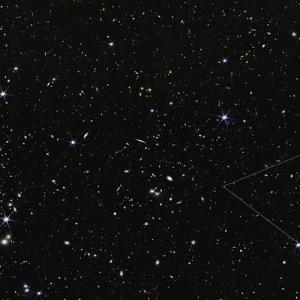
Researchers using the James Webb Space Telescope have made an exciting discovery about a galaxy named MoM-z14. This galaxy existed just 280 million years after the Big Bang, a tiny moment in the grand timeline of the universe, which is about 13.8 billion years old. Because of its age, MoM-z14 can help us understand the early days of the universe better.
Rohan Naidu from the Massachusetts Institute of Technology emphasized the telescope’s power: “With Webb, we are able to see farther than humans ever have before, and it looks nothing like what we predicted, which is both challenging and exciting.” The findings were published in the Open Journal of Astrophysics.
Using Webb’s Near-Infrared Spectrograph, scientists analyzed the light from MoM-z14. They noticed something surprising: high levels of nitrogen. This was unexpected, as early galaxies were thought to have lower nitrogen levels. Researchers are also curious about the process of reionization, where stars emit enough energy to cut through the dense hydrogen fog that existed when the universe was young.
Recent data suggests that more stars formed in the early universe than previously thought. For instance, a 2021 survey found that star formation rates were up to 50% higher than estimates from earlier models. This discovery challenges many long-held beliefs in astronomy and suggests a more dynamic early universe.
Yijia Li from Penn State shared her excitement: “It’s an incredibly exciting time, with Webb revealing the early Universe like never before and showing us how much there still is to discover.” The revelations from MoM-z14 are just the beginning, providing a tantalizing glimpse into the universe’s infancy.
For more details about the galaxy and Webb’s capabilities, check out the official announcement from the European Space Agency here.
Source link
James Webb Space Telescope, bright galaxy
