
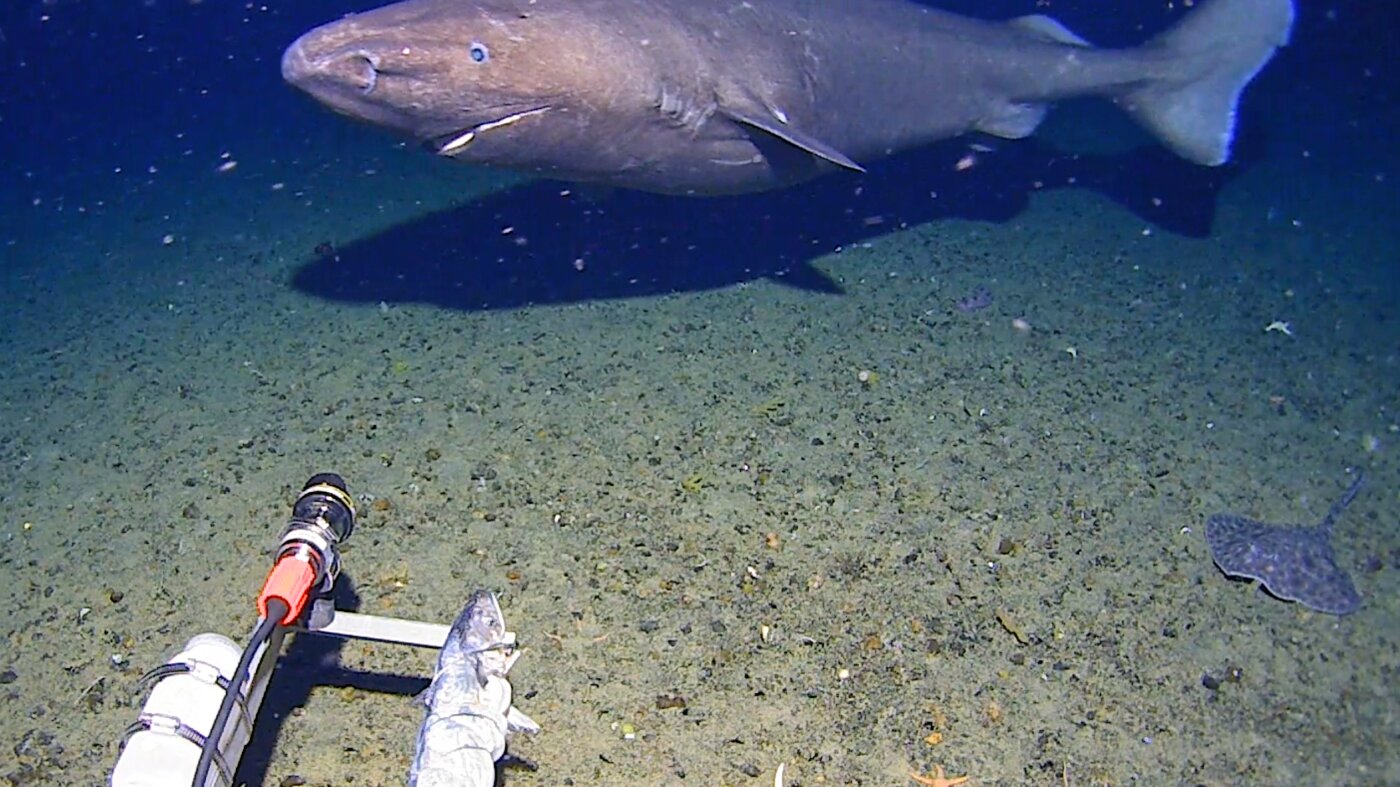
MELBOURNE, Australia — A surprising sight emerged from the icy depths of Antarctica: a sleeper shark. This hefty creature, estimated to be between 3 and 4 meters (10 to 13 feet) long, cruised along a dark seabed where sunlight never reaches. Researcher Alan Jamieson noted this discovery recently, highlighting how unexpected it was. Many scientists believed sharks didn’t inhabit these frigid waters.
“We went down there not expecting to see sharks because there’s a general rule of thumb that you don’t get sharks in Antarctica,” Jamieson explained. “And it’s not even a little one either; it’s a hunk of a shark. These things are tanks.”
This remarkable footage was captured by a camera positioned off the South Shetland Islands, part of the Antarctic Peninsula. The video showed the shark swimming at a depth of 490 meters (1,608 feet) in nearly freezing water at 1.27 degrees Celsius (34.29 degrees Fahrenheit).
Interestingly, a skate—a relative of sharks—was also present in the frame. Scientists already knew these creatures ventured this far south, but the sighting of a sleeper shark at this depth was revolutionary.
No records exist of sharks being found in the Antarctic Ocean before this encounter. Peter Kyne, a conservation biologist from Charles Darwin University, echoed Jamieson’s thoughts, noting the significance of the finding.
Kyne speculated that climate change might be pushing marine life to adapt to new habitats due to warming waters. He said, “This is great. The shark was in the right place, the camera was in the right place, and they got this great footage.” Yet, research on sharks in this region remains scant because of the ocean’s remoteness.
Jamieson believes sleeper sharks could have long existed unnoticed in these waters. “The shark was likely following the warmest layer of water,” he remarked. The Antarctic Ocean’s structure is layered, with cold, dense water at the bottom that doesn’t mix with melting ice above. This unique stratification means that finding shark populations here is challenging.
Interestingly, the presence of sleeper sharks at such depths could change what we know about marine life in these extreme conditions. With only limited research done during the Southern Hemisphere’s summer months—from December to February—much of the year remains unexplored. “The other 75% of the year, no one’s looking at all,” Jamieson noted, hinting at the many surprises that await discoverers in the depths of the Antarctic Ocean.
As this finding unfolds, it highlights the need for more research in the Antarctic region. With the consequences of climate change becoming more apparent, understanding how marine life adapts is essential. For now, this sleeper shark has opened a new chapter in our understanding of life in one of the Earth’s most extreme environments.
For more insights on oceanic research and marine life adaptations, check out resources from the [Minderoo-UWA Deep-Sea Research Centre](https://www.minderoo.org/deep-sea-research-centre/).
