
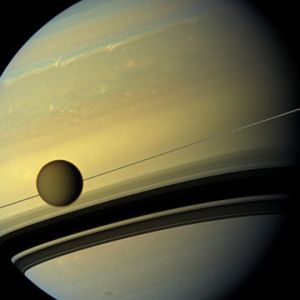
Saturn’s moon Titan is truly a fascinating place. Recently, researchers have made important discoveries about how Titan formed and how its history ties into that of Saturn itself.
Titan is the second-largest moon in our solar system, even bigger than Mercury. It’s so large that it affects Saturn’s tilt as it gradually drifts away at a rate of about 11 centimeters (4.3 inches) each year. Remarkably, some predictions suggest that one day, Titan could completely escape Saturn’s orbit.
Titan’s drifting path is just one of many mysteries surrounding Saturn and its 274 other moons. Most of our current knowledge comes from NASA’s Cassini spacecraft, which observed Saturn from 2004 to 2017.
A recent study suggests a new origin story for Titan. Researchers combined data from Cassini with computer simulations to propose that a smaller moon may have crashed into Titan about half a billion years ago. This collision could have helped form Titan as we know it today.
“By merging existing research, I propose this collision led to a unique combination that shaped Titan,” said Matija Ćuk, a scientist from the SETI Institute. This event might also explain the formation of Hyperion, one of Saturn’s other moons.
Research indicates that Titan may not have been alone. The collision might have scattered debris, possibly forming Saturn’s stunning rings. According to Ćuk, the aftermath of that impact could have nudged some of Saturn’s smaller moons into more collisions, paving the way for the rings we see now.
Scientists have uncovered clues about this ancient collision in Titan’s and Saturn’s current states. Saturn tilts at about 26.7 degrees—it’s not just the influence of neighboring planets like Neptune as was once thought.
The findings suggest the existence of another moon, dubbed “Chrysalis,” which was lost long ago. This moon once orbited Saturn and played a role in its tilt. Around 160 million years ago, it got too close to Saturn and broke apart, contributing to the rings.
Now, with the help of sophisticated studies, researchers like Ćuk believe the collision that formed Titan could explain why Saturn and Neptune are currently misaligned. The mass of the lost moon may have kept their orbits in harmony.
Before the advent of Cassini, astronomers mostly speculated about such connections. The spacecraft’s data has led to breakthroughs that reveal the complex dynamics between Orion’s moons. For example, Titan’s orbit is now expanding faster than previously expected.
“The Saturn system is like a dynamic clock,” noted Linda Spilker, a NASA scientist. Its moons spin and orbit in intricate ways that have fascinated researchers for years.
This latest study adds to our understanding of how these celestial bodies interact. As scientists continue to analyze data and prepare for future missions—like NASA’s Dragonfly, which aims to explore Titan more closely by 2034—we’ll get even clearer insights into this enigmatic moon.
In summary, Titan is not just a moon; it’s a key piece in understanding the larger Saturnian puzzle. The ongoing research offers a fresh perspective on how one of our solar system’s most unique features may have come to be.
Source link
Cassini spacecraft, moon Hyperion, Titan, lost moon, Saturnian system, SETI Institute
