
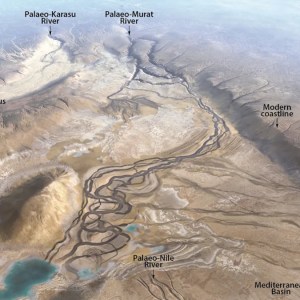
Researchers recently uncovered fascinating insights about the Euphrates River, possibly one of the most significant rivers in history. Around 5.4 million years ago, two rivers, the Paleo-Karasu and the Paleo-Murat, flowed across what is now Turkey and Syria into the Mediterranean Sea. Their merger eventually created the Euphrates, a river crucial for early civilizations in the Fertile Crescent.
The Paleo-Murat changed course first around 3.6 million years ago, followed by the Paleo-Karasu 800,000 years later. By roughly 1.6 million years ago, these rivers united to flow southeast into the Persian Gulf. Andrew Madof, a senior seismic stratigrapher at Chevron, emphasized this merging was pivotal. “Without that union, the Fertile Crescent may not have formed as we know it,” he explained.
The Fertile Crescent, often called the “cradle of civilization,” stretches from modern Egypt to southeastern Iraq. It’s in this area where two major rivers, the Tigris and Euphrates, created fertile land amid surrounding arid regions. This fertile soil helped ancient civilizations like the Sumerians and Assyrians thrive more than 6,000 years ago.
Until recently, the origins of the 1,900-mile-long Euphrates were shrouded in mystery. Some experts believed it came from a single river or areas in Turkey, while others proposed it might have started in the Arabian Peninsula. Recently published research in Nature Geoscience revealed that the Euphrates is indeed a product of the merging of two rivers, rather than a single body of water.
To reach this conclusion, researchers used seismic data and satellite images to trace the Euphrates’ geological history. They excavated ancient river deposits off the coast of Lebanon and compared them to those off Turkey, revealing the pathways of the Paleo-Karasu and Paleo-Murat. These rivers functioned together, flowing into the Mediterranean during a time known as the Messinian salinity crisis, when enormous shifts dried much of the sea. The Mediterranean refilled about 5.33 million years ago, burying the old pathways.
Understanding these ancient rivers helps us grasp how water distribution can reshape landscapes, affecting climates and ecosystems. Madof mentioned, “By studying the Euphrates, we can learn how large-scale changes in water availability impact life.” This information is crucial today as climate change alters water resources worldwide.
The research draws on technologies like sediment modeling to gauge the size and reach of these rivers, finding that they were even larger than the modern Nile before merging. This shift in waterways likely influenced animal migration routes during prehistoric times, showing how geography and ecology are connected.
In today’s context, the findings underscore the importance of rivers in shaping civilizations. As water resources face pressures from climate change, understanding historical river dynamics could prove invaluable for future planning and conservation efforts.
Source link
the Euphrates, Andrew S. Madof, Andrew Madof, Mediterranean Sea, Fertile Crescent, Paleo-Murat, Tigris and Euphrates, Paleo-Karasu River
