
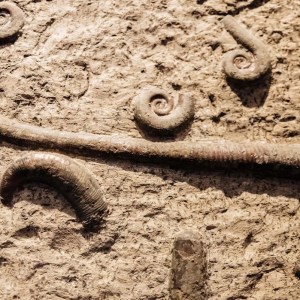
Scientists recently made a fascinating discovery in southwest China. Researchers uncovered around 700 fossils at a site known as the Jiangchuan Biota. This find offers fresh insights into the evolution of life on Earth, specifically during the period between the Precambrian and the Phanerozoic eons, our current geological timeframe.
Historically, scientists believed that the complex life forms we see today began to emerge suddenly during an event referred to as the Cambrian Explosion roughly 541 million years ago. However, the Jiangchuan Biota challenges that idea. Many of the fossils found here date back around 539 to 554 million years and include organisms that were previously unknown or only thought to exist in Cambrian rocks. This shifts the timeline, suggesting that complex life thrived much earlier than we once thought.
Among the fossils, researchers identified both ancient relatives of modern invertebrates, like starfish, and early ancestors of humans called bilaterians. These creatures have what’s known as bilateral symmetry, meaning their bodies can be split into two mirror-image halves. Interestingly, this discovery indicates that some life forms previously believed to have only existed during the Cambrian period were likely around much earlier.
Gaorong Li, a lead author of the study from Oxford University, emphasized the significance of these findings: “For the first time, we demonstrate that many complex animals typically found only in the Cambrian existed during the Ediacaran period.” This suggests a far more gradual evolution of complex organisms than previously thought.
Another exciting revelation was the presence of ambulacrarian fossils (like acorn worms) in the Ediacaran period. Frankie Dunn, co-author of the study, pointed out that this discovery supports the idea that chordates—animals with backbones—must have existed much earlier as well.
Why are these fossils just now being discovered? The researchers theorize that the unique carbon-rich rocks at Jiangchuan are rare and may have helped in preserving these fossils better than in other known sites.
This new information reshapes our understanding of evolution’s narrative. If the Cambrian Explosion is viewed as the climax of life’s story, the evidence from Jiangchuan suggests there’s more to the buildup than we once realized.
Overall, the Jiangchuan Biota opens up exciting possibilities for understanding how life on Earth evolved, prompting scientists to rethink the chapters of our planet’s history. For more insights on this research, check out the full study published in Science.
Source link
Jiangchuan Biota, Cambrian Explosion, Yunnan University, Ediacaran period, Jiangchuan, Cambrian period, fossilized animals, Fossils
