
Scientists have made an amazing discovery: a microwave laser beam located 8 billion light-years away. This “gigamaser” is about 100,000 times brighter than a typical star. A gigamaser is a powerful version of a maser, which usually emits radio waves instead of visible light.
These hydroxyl masers form during galaxy mergers. When two galaxies collide, they compress gas and excite hydroxyl molecules. This creates a concentrated beam of amplified radio waves.
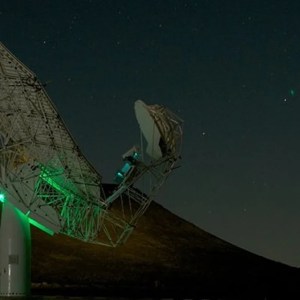
The discovery came from a team using the MeerKAT radio telescope in South Africa. They found this signal in a galaxy named HATLAS J142935.3–002836. This galaxy is currently undergoing a spectacular merger, and it represents the furthest galaxy of its kind ever observed. Interestingly, our own Milky Way will face a similar but smaller merger in the future.
Astronomers were fortunate to spot the signal. A nearby galaxy aligned perfectly between Earth and HATLAS, amplifying the maser’s signal due to its significant mass and the way it curved space-time. Without this alignment, the signal might have remained undetected.
The MeerKAT telescope is exceptionally sensitive, capable of capturing around 2.5 terabytes of data every hour. Advanced processing helps the team sift through this huge volume of information to spot faint signals like the gigamaser. They believe there are many more masers waiting to be discovered, potentially revealing insights into galaxy formation and evolution.
Recent studies show that masers are common in massive galaxy mergers. According to research from NASA, such events can trigger bursts of star formation and even reveal the presence of supermassive black holes. Discovering these cosmic phenomena could reshape our understanding of the universe.
You can read more about this fascinating discovery here and find insights from other credible sources as well.
Source link
radio telescope, distant galaxy, MeerKAT
