
We’re getting closer to answering a big question: Did life ever exist on Mars? April has been a game-changer for this search, especially as NASA looks to send humans to the red planet in just a few years.
Recently, scientists discovered geological features that might be the remnants of a vast ocean on Mars. Another team analyzing samples from NASA’s Curiosity rover found seven new organic molecules that had never been seen before on Mars. While these discoveries don’t confirm life, they both add to the growing evidence that Mars once had conditions suitable for life.
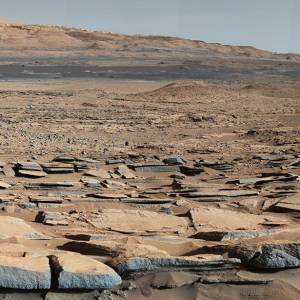
Curiosity’s findings are particularly exciting. The rover collected and analyzed a rock sample in 2020. Just this year, results showed the “most diverse collection of organic molecules” found on Mars. Out of 21 carbon-containing molecules identified, seven are new to the Martian landscape. This is a big deal! By studying these molecules, scientists hope to determine if they came from ancient microbial life or were formed through geological processes. NASA warns we can’t jump to conclusions yet, but the chemistry suggests ancient Mars had a favorable environment for life.
Digging deeper into Mars’ past, researchers believe it once housed a huge ocean, not just a lake or river. A study in *Nature* shows a flat band of land that resembles a continental shelf, wrapping around the northern hemisphere of Mars. It’s like a “bathtub ring” left behind when the water receded. The study leaders from the California Institute of Technology suggest that this ancient ocean took up a third of Mars’ surface, making the case for a Mars that could have been teeming with life.
Water is essential for life as we know it. So, finding signs of water on Mars has been a key focus for scientists. This new evidence strengthens the notion that Mars might have once supported life.
Looking ahead, NASA is preparing to send a nuclear-powered spacecraft to Mars in 2028. This mission, called Space Reactor-1, will test technology that could help power future human operations. As dust storms on Mars can block sunlight for weeks, this fission technology could be crucial. The spacecraft aims to reach Mars in 2030 and will deploy helicopters to scout possible landing sites and search for underground water sources.
As both the Curiosity and Perseverance rovers continue to explore different parts of Mars, the excitement builds. With NASA’s Artemis program also sending humans back to the moon, future missions to Mars will bring us closer to potentially discovering if life once flourished there.
In the world of public interest, discussions on social media have exploded regarding made-in-space technology and the potential for human life on Mars. Users are fascinated by what these discoveries mean for humanity’s future. As we learn more, the bridge between science fiction and reality shrinks ever closer.
Keep your eyes on the sky! Every discovery takes us one step closer to revealing Mars’ ancient secrets.
Source link
NASA, Curiosity rover, organic molecules, Mars, researchers
