
Electric trucks are on the rise in China, bringing a fresh twist to the vehicle market as traditional car sales see a decline. At a recent auto show in Beijing, a large electric truck stood out among smaller passenger cars, highlighting a shift in consumer interest.
Sales of electric trucks have surged. According to reports, they now account for 20% of the truck segment, with monthly sales hitting over 24,000 units in March. This is a sharp increase, especially considering a dip in February due to the Lunar New Year celebrations.
Fleet operators are increasingly making the switch to electric trucks. Xu Shuo, CFO of GAC Lingcheng, notes that financial calculations are a big driving force behind this change, beyond just government regulations. Competing with major brands, GAC Lingcheng is seeing more businesses recognizing the long-term savings of electric models, despite their higher upfront costs. With government trade-in incentives, buyers could recover the price difference in just a year through fuel savings.
Recent spikes in fuel prices, partly due to the war in Iran, have made the economics of electric trucks even more favorable. For example, liquefied natural gas prices surged 53%, and diesel increased by 35%. While it’s generally cheaper to run trucks on electricity, actual costs can vary based on location and time of day, as noted by Maynie Yang from BloombergNEF.
“Higher diesel prices could further stimulate electric truck sales, but it may take some time for fleets to react,” Yang explains.
Even before the spike in fuel prices, the trend toward clean trucks was gaining momentum. Advances in battery and charging technology are making it easier to transition to electric vehicles, both in China and Europe. The latest estimates suggest that electric heavy-duty trucks could make up 63% of total sales in China by 2035, even without additional regulatory pressures.
But challenges still exist. Most heavy-duty electric trucks are currently used for short distances, like between ports and factories. The Chinese government is aware of this limitation and is planning to establish 6,200 miles of zero-emission freight corridors by 2030. As of September, there were plans for around 9,000 new charging stations, helping to bridge the gap.
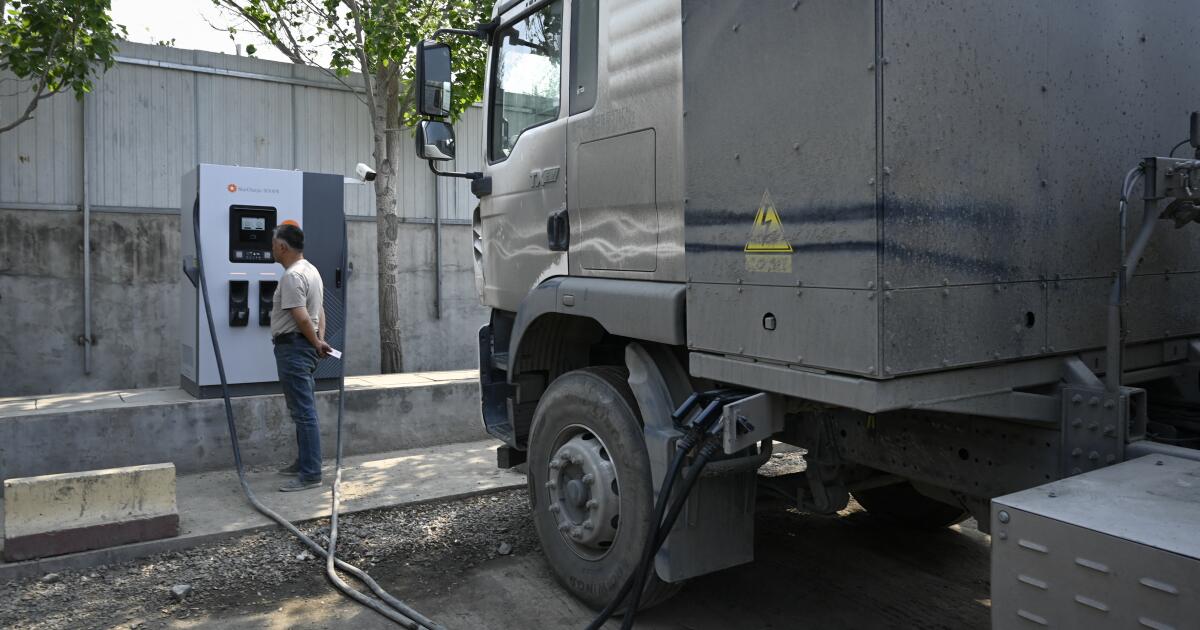
One truck driver, known only as Shen, shared his experience at a new charging station in Hebei province. He typically transports construction materials over a 105-mile route from Tianjin to Baoding. His fuel costs were around $37, but charging now only costs him $17.50. “Charging may take some time,” he said, “but I plan it along with my breaks, and it’s not an issue. The cost savings really make a difference.”
As electric trucks carve out their niche, they are becoming an integral part of the future transport landscape. With costs on the rise for traditional fuels and a supportive government framework, many believe the momentum towards electric vehicles is here to stay.
Source link
