
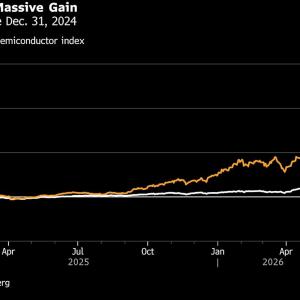
Micron Technology Inc. is having a remarkable year, ranking as one of the top performers in the S&P 500 Index. Yet, this success comes with a twist: its stock is also among the least expensive available. While this might seem positive, it can hint at more troubling signs for investors.
Micron’s price-to-earnings ratio sits at just 10. This is the lowest in the Philadelphia Stock Exchange Semiconductor Index, a position it has held for almost two years. This makes it one of the 50 cheapest stocks in the S&P 500, closely following United Airlines. Interestingly, Sandisk Corp., the top stock this year with a staggering increase of 570%, also operates in the memory chip space and sports a similar low valuation.
Given the sky-high demand for artificial intelligence tech, one might assume that companies like Micron would be safe bets. However, analysts suggest that these low valuations could be signals that their earnings growth may have peaked. John Porter, chief investment officer at AGF Investments, notes a trend: when stocks carry low valuations, it often indicates potential trouble ahead.
In its latest quarter, Micron achieved a revenue surge almost three times higher than before, marking its fastest growth since 1990. Since the end of 2024, the stock price has jumped over 1,000%. This momentum has also helped elevate the chipmaker index, which has gained 79% this year, while the tech-heavy Nasdaq 100 Index has climbed 19%.
Historically, memory-related stocks behave differently, often cycling with demand for PCs and smartphones. Investors typically find these stocks cheapest when the market has peaked, and most expensive during lower-demand spells. It’s a cycle Micron experienced as recently as 2023.
Current discussions center around the impact of massive investments in AI infrastructure. Some believe that this spending could redefine the industry’s cyclicality. Notable firms like Microsoft, Amazon, and Alphabet are pouring billions into this area, raising questions about whether Micron’s low multiple could be a sign of opportunity rather than risk.
Given these points, Wall Street is rethinking how to value Micron and similar firms. Analyst Timothy Arcuri from UBS believes that Micron should be valued like leading AI chipmaker Nvidia, which trades at about 21 times forward earnings. He projects a price target of $1,625 for Micron, suggesting significant upside.
However, there are reasons to be cautious. Micron’s stock has recently been deemed overbought by technical traders. Average analyst forecasts suggest a potential 22% drop in price over the next year, which isn’t promising compared to other chipmakers.
Andrew Rocco, a strategist at Zacks Investment Research, warns that a slowdown might be on the horizon. Historical patterns suggest that stocks experiencing rapid gains often face corrections as fundamentals weaken.
Looking at social media, user sentiments about Micron display a mix of optimism and caution. Discussions surrounding its performance, driven by the AI boom, have gained traction. Some investors remain excited about potential growth, while others express concern about a looming downturn.
In summary, while Micron Technology has enjoyed immense growth, its low valuation and historical patterns of memory stocks present a complex picture. Investors would do well to monitor industry trends closely, especially as the landscape continues to evolve with AI developments. For deeper insights into market dynamics, you can refer to resources like the U.S. Securities and Exchange Commission or financial news platforms.
Source link
Micron Technology Inc, John Porter, Bloomberg, earnings growth, artificial intelligence, Sandisk Corp., memory chips
