
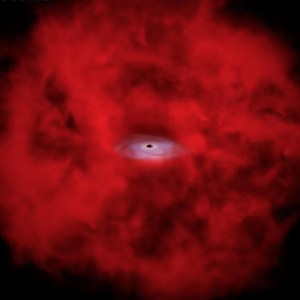
Astronomers have made a fascinating discovery regarding the mysterious “little red dots” in the universe. A new specimen, dubbed the “X-ray dot,” offers new insights into these enigmatic celestial objects. Researchers believe these dots represent an unusual and extreme phase in the evolution of supermassive black holes.
A recent study published in The Astrophysical Journal Letters revealed this breakthrough. Using data from NASA’s Chandra X-ray Observatory and new images from the James Webb Space Telescope, scientists observed a red dot emitting X-rays, a key indicator of black hole activity. Lead author Raphael Hviding from the Max Planck Institute for Astronomy likens this discovery to finding the missing piece of a puzzle that connects all the red dots.
These dots are not just any cosmic objects; they are remarkably massive entities from the early universe that are no longer visible today. Until the James Webb Space Telescope began its observations in 2022, the existence of these dots was completely unknown. Most are located about 12 billion light-years away, and some date back to a time when the universe was less than a billion years old.
For years, scientists puzzled over what these dots could be. They don’t fit neatly into existing categories: they are too large to be stars but too compact to be entire galaxies. Many experts suspected that they might be closely tied to rapidly growing supermassive black holes. However, previous observations didn’t show the typical signs of black hole activity, like bright emissions from swirling gas.
The identification of the X-ray dot changes the narrative. It strengthens the theory that these little red dots might actually be “black hole stars,” where a supermassive black hole is engulfed in a dense cloud of gas, thereby hiding its emissions. Co-author Hanpu Liu from Princeton University emphasized that if confirmed, this would be a groundbreaking finding—potentially the first to reveal the innermost workings of a little red dot.
This discovery opens doors to understanding how supermassive black holes grow in the universe. Recent surveys indicate that black holes are more common than previously thought, as new research suggests that they may be at the core of many galaxies. According to a 2022 study, around 90% of massive galaxies likely host supermassive black holes, making this research vital in piecing together the cosmic puzzle.
Social media has been buzzing with excitement over this discovery, with many users sharing artist impressions and highlighting the significance of this research. Astronomers and space enthusiasts alike are interested in how these findings could reshape our understanding of cosmic evolution.
As we continue to explore the depths of the universe, each new finding, like the X-ray dot, shines a light on the mysteries that envelop us. You can read more about other exciting space discoveries, like the detection of an atmosphere on a planet-like object beyond Pluto, here.
Source link
supermassive black hole, little red dots, James Webb Space Telescope, NASA
